How much per hour does a commercial plumber charge?
This page carries no dollar figure, because no local commercial rate was verified. What is documented is the wage underneath: a national median of $30.67 hourly for the combined group of plumbers, pipefitters and steamfitters, as reported by the Bureau of Labor Statistics. Businesses bill far above that, because the rate has to cover much more than pay.
Picture a commercial hourly rate as a stack. The worker's pay sits at the base. Payroll taxes and benefits, insurance, a loaded truck, tools and testing gear, dispatch and office staff, and permits go on top. Add a margin and you arrive at the figure on the bid. A Simi Valley shop offering "one rate, all in" and one that lists travel and materials separately may end up at similar totals.
The Arroyo Simi Plumbing home page explains how the service works; use the sections that follow to interpret the bids you receive.
Why does commercial pricing differ from home pricing?
Jobs in commercial buildings tend to be bigger, more regulated and more exposed to downtime. A restaurant grease trap, a shop's backflow device, a multi-unit riser or a landlord's hot water system means larger pipe, tougher inspection and more liability than a kitchen faucet, and businesses price accordingly.
Differences you may see in a bid:
- Scope and size. Larger pipe, heavier fittings, lifts or scaffolding.
- Compliance. Permits, inspections and testing records the building owner must keep. Backflow testing is covered on its own page.
- Access and timing. Night work that lets the shop open on schedule is priced above a weekday visit.
- Insurance. Commercial jobs usually require proof of cover before anyone starts.
A homeowner repair involves fewer of these factors, which is why the general plumber cost guide reads differently.
What do the journeyman and master tiers mean for rates?
Pay tiers in plumbing mirror experience: an apprentice or helper at the base, a journeyman who has finished training and works alone, and a master or foreman who supervises and signs off. Businesses often bill a blended crew rate, or a higher rate for the senior person, so ask which applies.
According to the Bureau of Labor Statistics, most plumbers learn the trade in an apprenticeship lasting 4 or 5 years, with roughly 2,000 hours of paid on-the-job training annually. Journeyman and master describe experience; what matters to you is that the business taking the work holds a California contractor license from the Contractors State License Board. Look up that license number prior to accepting a bid, and ask whether the person doing the job works for that license holder.
How do I work out a fair hourly rate?
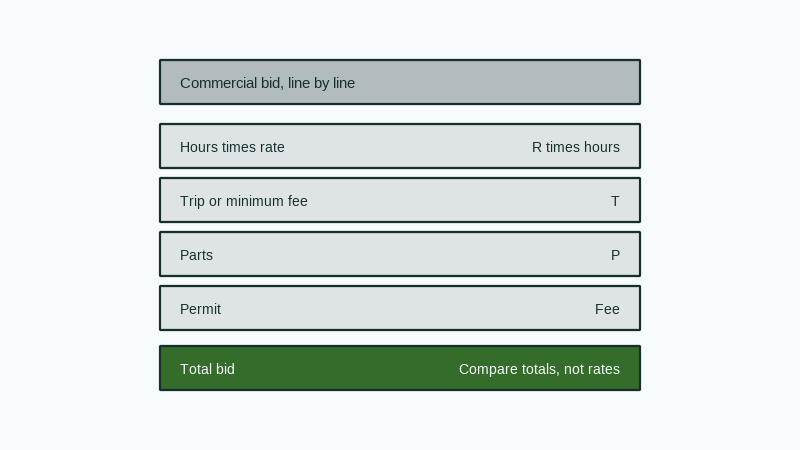
Use a simple check: estimate the hours, multiply by the quoted rate, then add materials, any trip or minimum charge and the permit cost. When comparing two bids, make sure they cover identical scope. A lower hourly rate with a longer estimate often costs the same as a higher rate with a shorter one.
A worked pattern, with made-up numbers for illustration only: a bid of 4 hours at a rate of R, plus a minimum or trip fee T, plus parts P, totals 4R + T + P. A second bid of 5 hours at a lower rate r gives 5r + T2 + P2. For the same scope, whichever total is lower is the cheaper bid, whatever the hourly figure suggests.
Put these to each business before agreeing:
- Is the rate per person or per crew?
- Is travel billed, and does a minimum number of billable hours apply?
- Who supplies parts, and what is the markup?
- How does the bid handle a problem that proves larger?
- Who pulls the permit, and is it in the price?
Is an emergency or after-hours call pricier?
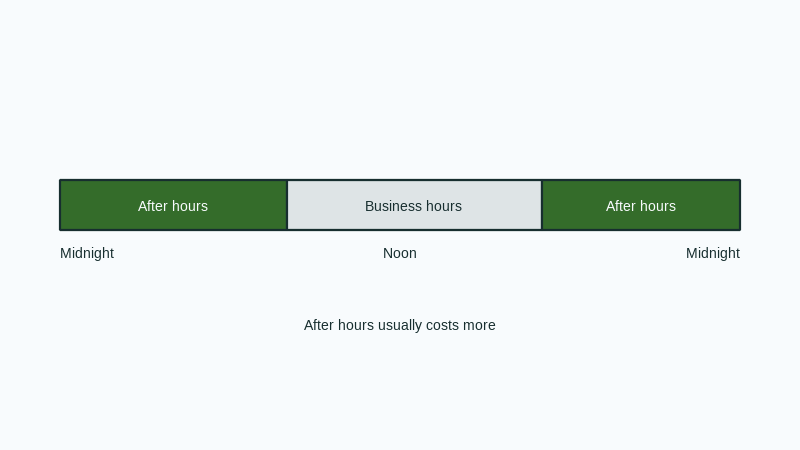
Usually, yes. Evening, weekend and holiday work is commonly billed above the weekday rate, because the business pays its people more for those hours. If a leak can be contained by closing a valve, a daytime booking will normally cost less than an emergency dispatch. A gas smell is never a reason to wait.
Smell gas? Exit the building first, then report it from outside to SoCalGas at 1-800-427-2200, or to 911 if anyone is in danger. If a burst pipe or flood hits a business, close the main water valve before anything else and then arrange help; the page on emergency plumbing covers it.
What belongs in a written commercial bid?
A proper bid spells out the work, the materials, the labor basis, any trip or minimum charge, who pulls the permits and how a change of scope is handled. The bid should carry the license number the contractor holds in California. State law generally requires a license once labor and materials add up to $1,000, and any job that needs a permit requires one whatever the price.
Simi Valley handles building permits through its Building and Safety Division, which has a page on the city website; confirm hours and requirements before relying on a timeline. Ask whether the plumber books the inspection, and what follows if the job fails on the first attempt. Keep the bid, the invoice and any test records, since a landlord, insurer or the water supplier may ask for them later.
To collect a bid for your property, send a commercial plumbing request with the address area, the problem and the access hours. A person reads requests between 9am and 5pm on weekdays, and a local plumber is arranged afterward.
Common questions
What is the average hourly charge for a plumber?
No local figure has been verified. The Bureau of Labor Statistics reports that plumbers, pipefitters and steamfitters earn a median of $30.67 an hour nationally, and a business bills more because it covers insurance, vehicles, tools and overhead. Request written bids and compare totals, not rates.
How can I tell whether a plumber's hourly rate is fair?
A fair rate fits the scope, comes with a written bid and a clear minimum, and lands near other bids for the same work. A rate far below the rest may omit parts, travel or permits. Compare totals for the same job.
How much does a master plumber usually bill?
It differs by business and the state does not set it. A master or senior plumber often bills more than a journeyman because of supervision and sign-off duties. Ask whether the quoted rate applies to the person who will actually be on site.
Can I calculate a plumber's hourly cost myself?
You can build your own: hours times rate, plus parts, minimum or trip fee and permit cost. Ask each business for those lines separately. The worked pattern above shows how two bids with different rates can cost the same.
Do commercial plumbers need a license in California?
Yes. A California business needs a contractor license once combined labor and materials reach $1,000, and also whenever a permit is involved. Search for the license number on the Contractors State License Board website and confirm it is active before work starts.
Is a commercial rate the same in Moorpark as in Simi Valley?
Not necessarily. Each business sets its own rate and travel policy, and the distance to your site changes any trip charge. The two cities also run separate permit offices, so ask each bidder to state travel and permit terms in writing before you compare.