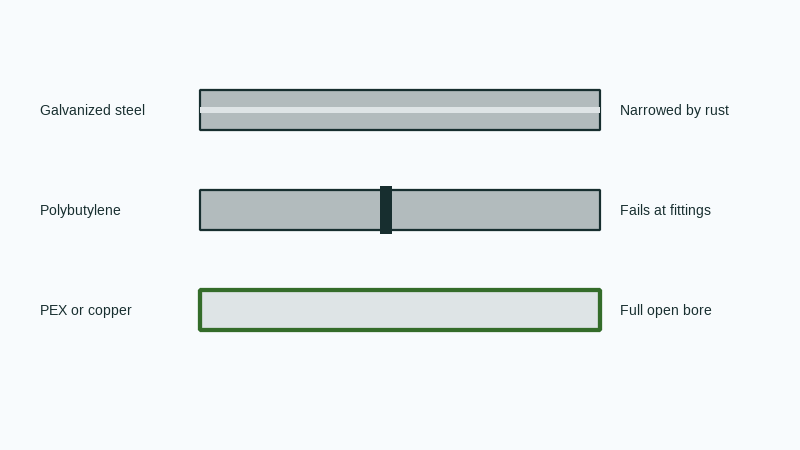
Repiping replaces the supply pipes running between the meter and every faucet, toilet and appliance, usually with PEX or copper. Plenty of Simi Valley and Moorpark owners arrive at that decision after repeated leaks, discolored water or weak flow. What you send us goes on to a nearby plumbing company, which sends someone to inspect the house and then writes up a quote. The businesses that take requests pay Arroyo Simi Plumbing a fee. You can begin at the home page or use the quote form directly.
Is it time for new pipes in my house?
You probably need one if the house still has galvanized steel or polybutylene supply pipe, if pinhole leaks keep showing up in different places, or if water runs brown and weak at every fixture. A single leak in an otherwise sound system rarely justifies replacing everything. A plumber can tell which case applies by checking the pipe material and where the leaks occur.
Many older houses were first plumbed with galvanized steel, which corrodes from the inside and narrows over the years. Some US houses put up between roughly 1978 and 1997 were plumbed with polybutylene, a gray plastic with a bad track record. Check where the pipe comes into the garage or runs under a sink. Gray plastic, or dull threaded steel, tells you what is there.
Newer houses are mostly different, and repiping them is less common. Copper with pinhole leaks is the other typical trigger, and the page about pinhole leaks in copper pipe explains when patching is still reasonable.
What happens during a whole-house pipe swap?
The plumber starts by shutting off the water, then pulls new lines through walls, attics, crawl spaces or under a slab, reconnects every fixture, and cuts small openings in the drywall that get patched afterward. The old pipe frequently stays in the wall rather than being removed. Water is unavailable while connections are made, so a good plan accounts for each day.
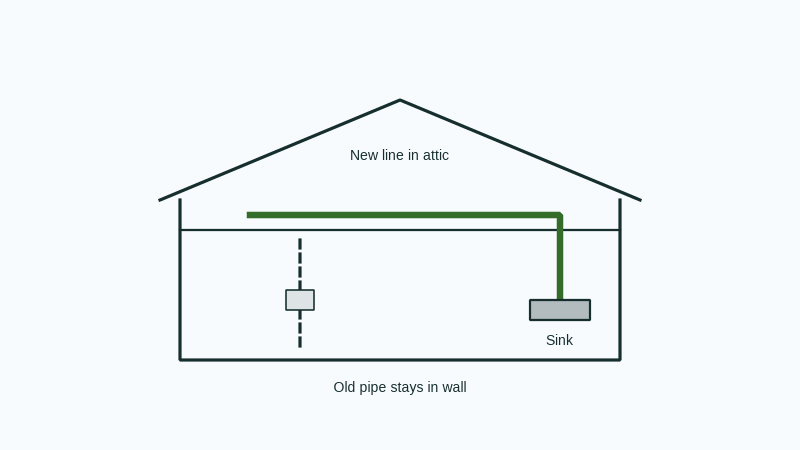
Most repipes go in from the attic or crawl space, which holds wall openings to a minimum. Slab houses are harder, because lines may be rerouted overhead instead of being cut out of the concrete. If the leak is already below the floor, ask whether slab leak repair or a repipe suits the house better.
On many jobs the plumber also installs a new pressure-reducing valve, and the finished lines are pressure tested before any wall is closed up. Ask for these steps in the quote, so the bids can be set side by side item for item.
How many days does a full repipe take?
A typical one-story house needs a handful of working days, while a larger two-story home or a slab house can take more. Get a written schedule from the plumber stating how many hours the water is off each day and who patches and paints the drywall, since those trades are sometimes separate.
Main drivers are the number of bathrooms and fixtures, how easy the attic and crawl space are to reach, and the wall finishes. Plaster, tile backsplashes or finished basements need extra care. Open attic access usually puts a house near the quick end. Ask whether the plan covers the permit and the inspection, since an inspection may need booking early.
What does repiping a whole house cost?
No reliable number exists without a site visit, so we print none. Price follows fixture count, the material you choose, how many wall openings are needed, whether the house is on a slab, and what patching and paint add. Collect at least two written quotes that cover identical work.
Ranges and the line items that shift the price are in the guide on repipe house cost in Simi Valley. For a house of 1,500 square feet, expect the quote to depend on the count of bathrooms, kitchens and laundry hookups, not on floor area alone. A small home holding three bathrooms can cost more than a bigger one with only one.
A cheap bid rarely means less work. Ask what is included: permit, patching, painting, a new shutoff and pressure reducing valve, and debris removal.
Does homeowners insurance pay for repiping?
Homeowners policies typically pay for sudden, accidental damage, for example when a pipe bursts and floods a room, but they usually exclude replacing pipes that wore out or corroded slowly. Your policy's wording decides, so read it ahead of any work and put the question to your insurer directly instead of guessing.
If a burst has already damaged the house, see insurance and burst pipes for what to record. Take dated photos, keep the failed pipe section where possible, and save every receipt. Describe events factually, in brief, accurate answers. Do not guess the cause, and do not say anything is covered until the insurer does.
A repipe done to prevent leaks, with no damage yet, is usually treated as maintenance paid by the owner.
Which should I choose, PEX or copper?
Each material works, and neither wins everywhere. PEX flexes easily, goes in faster and often lowers labor cost. Copper is stiff, lasts for decades and tolerates heat and sunlight better. Water chemistry, budget and how comfortable the plumber is with a material should decide. Ask each bidder to explain the reasoning.
The PEX versus copper comparison goes through freezing, fittings, noise and lifespan. Because most of Simi Valley gets imported water that can be hard, read your district's annual water quality report and ask the plumber whether it changes the advice. Your water bill shows whether Ventura County Waterworks District No. 8 or Golden State Water serves you.
How do polybutylene and galvanized pipe fit in?
Either is a solid reason to replace, and neither belongs in a system you plan to keep. Galvanized pipe corrodes and chokes flow. Polybutylene can fail at its fittings without warning. Each has its own page: replacing polybutylene pipe and replacing galvanized pipe.
Many people search for a polybutylene replacement program. We know of no current program for Simi Valley homes, so we promise none. Ask both the plumber and your insurer whether anything might apply to your house.
To see how often a house needs this work, read the usual repipe interval and why people repipe. There is also a walkthrough of how a repipe is done step by step.
Could I repipe the house myself?
Some owners could in principle do their own plumbing, but a whole house repipe involves permits, inspections and pressure testing, and mistakes stay buried inside walls. A permit is usually required, so hiring a contractor holding a California license is safer. Look at your city's Building and Safety web page before starting.
In Simi Valley, permits come from the City's Building & Safety Division, and in Moorpark from the City of Moorpark Building & Safety. Each site lists contact details, so confirm requirements and hours before visiting. Gas lines and the water main are where owners should stop and leave the work to a professional.
Common questions
Which plumbing pipe material is the most recent?
Current new work mostly uses PEX, which has been common for years. Copper remains a standard choice, and some homes receive CPVC. Which material is newest matters less than whether it suits your water and your house, so have the plumber explain the pick in plain terms.
How does the plumbing in a house work?
A house has two systems. On the supply side, pressurized water travels from the meter out to the fixtures; on the drain side, wastewater leaves by gravity while vents let air in. A repipe replaces only the supply side. Drains and vents are separate and get touched only when they are failing.
What would redoing the plumbing cost in a 1500 square foot home?
No honest single figure exists, because the count of bathrooms, kitchens and laundry hookups, plus attic or slab access, outweighs square footage. Two written quotes with matching scope tell you more than any average. The repipe cost guide lists what moves the price.
Does a plumbing "135 rule" exist?
We could not confirm any recognized plumbing rule under that name, so we offer no guess. If a contractor or article cites it, ask which code section it comes from. For pipe sizing, pressure or temperature questions, have the plumber show the requirement in writing.