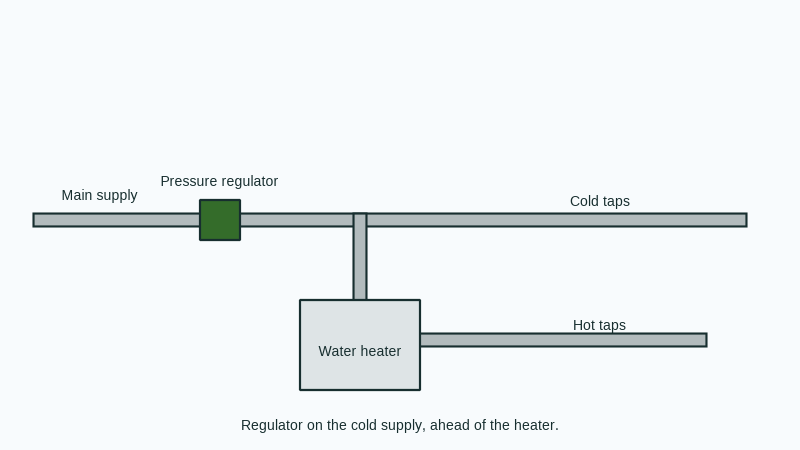
People search for a hot water pressure regulator expecting a part bolted to the hot pipe. In most houses, no such part exists. A pressure-reducing valve is installed on the incoming cold supply ahead of the water heater, so hot and cold both emerge at a controlled pressure. When hot water misbehaves the regulator is a suspect, as are the heater itself and its fittings. Use this page alongside the water heater repair guide, and send a request if you want it inspected.
Is there a pressure regulator for hot water only?
Seldom. A few specialty point-of-use valves are rated for hot water, yet a typical home relies on one pressure-reducing valve on the cold main, which feeds the heater and the cold taps alike. If only the hot side misbehaves, the cause is more often the heater, a mixing valve or scale than a regulator.
A regulator rated for hot water costs more because its seals must tolerate heat. Fitting a cold-rated valve on a hot line shortens its life and can fail suddenly. That is one reason to let a plumber choose parts. If a weak hot tap is your worry, start with the page on weak pressure on the hot side; it lists causes before you spend money.
How is the regulator positioned compared with the water heater?
Upstream. It is fitted to the main line at the point water enters the house, typically close to the shutoff valve in the garage, a side yard or a utility closet, so the heater receives reduced pressure on its cold inlet. All downstream pipework, the hot side included, inherits that pressure.
The valve to look for is brass and bell-shaped, with a screw on top. Further pages cover finding the regulator and spotting one by sight. A heater on a closed system, in which a regulator or check valve keeps water from flowing back into the main, needs somewhere for thermal expansion to go, and the usual answer is an expansion tank. Without one, pressure spikes each time the heater fires, and the relief valve may drip.
What does pressure do to a water heater?
Excess pressure strains the tank, the relief valve, the connectors and the faucets. Expect a dripping relief valve, a shorter tank life and banging in the pipes. Too little pressure makes showers weak and keeps tankless heaters from firing because flow falls below their minimum.
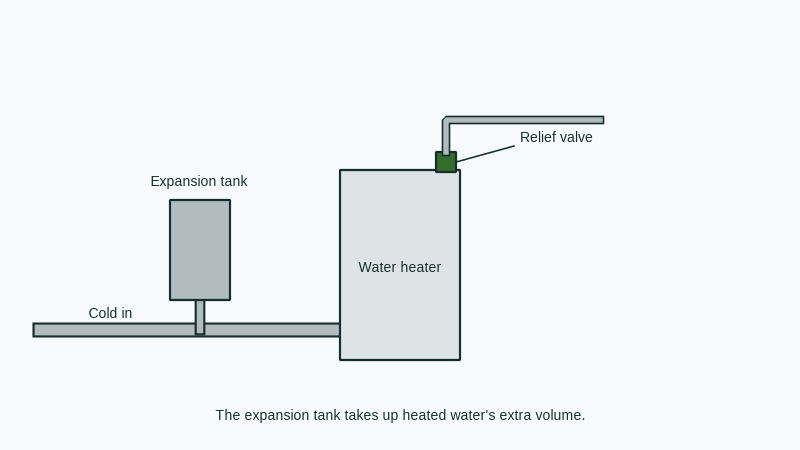
Heating water also raises pressure in a closed system. That is why a house with a regulator often has an expansion tank near the heater. If the relief valve drips only while the heater runs, expansion is a likely cause; the page on relief valve replacement explains the rest. Do not plug the valve: it is a safety part.
Can a bad regulator affect hot water?
Yes, indirectly. If a regulator fails, pressure can creep upward, surge and make noise, or flow can be choked so showers run weak on both sides, which feels worse on hot because mixing valves react. A stuck regulator can also pass high pressure to the heater and make the relief valve drip.
Signs include banging when valves close, a dripping relief valve, uneven shower flow, fixtures that wear out early and gauge readings far above normal. To check, a plumber threads a gauge onto a hose bib. The page on replacing a regulator explains what that involves, and the knock is covered under water hammer sounds.
What will a plumber inspect for pressure and hot water?
The plumber reads static pressure on a gauge, compares it with the regulator's setting and the fixtures' ratings, inspects the age and condition of the regulator, and examines the heater's expansion tank and relief valve. Adjustments are made at the regulator's screw, and the reading is taken again with water running.
Ask for the before-and-after numbers. If the house has no regulator, ask whether the incoming pressure justifies one. Your supplier, either Ventura County Waterworks District No. 8 or Golden State Water in Simi Valley, or District No. 1 in Moorpark, can tell you what pressure to expect, though your own reading is the one that counts.
Can I adjust or replace the regulator myself?
A careful homeowner with a gauge can handle adjustment: loosen the locknut, give the screw a slight turn, then recheck. Swapping the unit belongs to a plumber. It means cutting into the main, matching sizes and checking for leaks, and in California the work falls under contractor rules.
Combined labor and materials of $1,000 call for a contractor license, as does any job that requires a permit. Whether a regulator swap requires one is up to the city, so check with the Building and Safety Division in Simi Valley or the Building and Safety office in Moorpark. We read form requests on weekdays between 9am and 5pm. Sizing basics appear under whole-house regulators. Other jobs are on the Arroyo Simi Plumbing home page.
Common questions
Where is the water heater pressure regulator?
It sits on the cold supply feeding the heater, or more often on the main line at the point water comes into the house. The valve is brass, bell-shaped and has an adjusting screw. Trace the main line from the shutoff valve. If none turns up, the house may lack one; having the pressure tested by a plumber shows whether one is needed.
Is an expansion tank required when there is a regulator?
Frequently. Once a regulator or check valve seals off the main, heated water that expands has nowhere to go, and the tank gives it room. Warning signs include a dripping relief valve and pressure surging whenever the heater runs. A plumber can test and advise.
What goes wrong when a regulator fails?
Pressure can climb too high or sink too low. High pressure brings noise, leaks and wear, plus a dripping relief valve. Low pressure weakens showers and starves tankless heaters. A reading from a hose bib gauge shows which. Replacement is usually quick for a plumber. Note the age of the valve when you test.
Is hot water pressure always lower than cold?
Slightly, in many homes, because hot water passes through the heater, valves and longer pipes. A large gap signals a restriction, for example scale buildup, a valve open only partway or an aging fitting close to failure. Check the aerators and the shutoff valves first, then ask a plumber to measure.