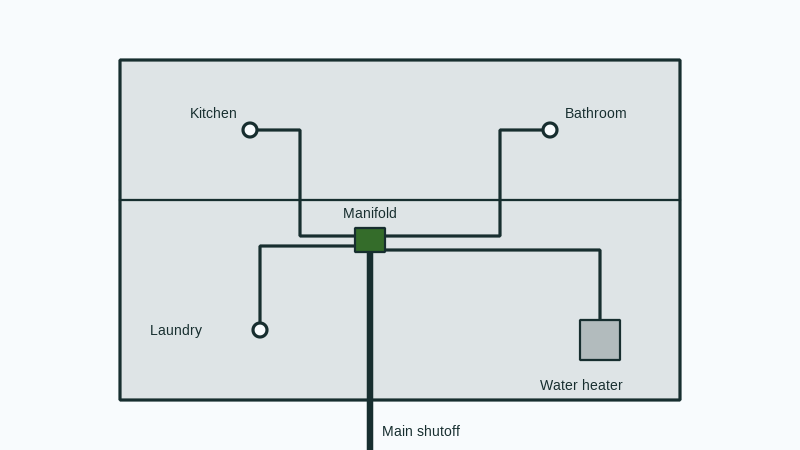
In a repipe, the water supply lines inside your walls, floors and ceilings are replaced, usually with PEX or copper, so the house stops developing leaks. A plumbing contractor performs the job under a permit, and for a typical house it generally takes a few days. This page walks through the stages, while our main guide to repiping and pipe replacement asks whether a repipe is worth doing.
In what order is a house repiped?
Nearly every house follows one sequence: survey the system, shut off and drain the water, cut in the new lines, connect each fixture, pressure test, then patch the walls. As the lines are swapped, the house is without running water for part of each working day.
At the start the plumber traces the current layout and decides where the new trunk and branch lines will go. Then the main is turned off, the system is drained, and access holes are cut in the drywall at chosen spots, usually behind fixtures and in closets rather than mid-wall. Fresh pipe is pulled through and tied in to the main and to each tub, sink, toilet, washer and water heater, and the old lines are then sealed off or taken out. The job ends with a pressure test, an inspection and drywall patching.
What follows once the new pipe is installed?
After installation, the plumber pressurizes the lines and holds the pressure to see whether it falls, then requests the city inspection. The walls close only once it passes. Taps may run cloudy or spit air briefly, which is normal and clears as you flush each fixture.
Expect drywall patches, which may or may not include texture and paint depending on the contract. Read the quote to see whether the plumber patches and paints or only leaves holes ready for a drywall crew. Test the water pressure at the taps afterward, and ask whether a pressure regulator and an expansion tank were set up, since a new system copes poorly with high pressure. Store the permit sign-off and any warranty paperwork together.
Is a do-it-yourself repipe realistic?
Some homeowners do plumbing on their own homes, but a whole-house repipe requires a permit, an inspection and careful pressure testing, and the city building office decides what an owner-builder may do. A mistake inside a wall shows up months later as water damage, so most people hire a plumbing contractor who holds a valid California license.
According to the Contractors State License Board, a license is generally needed when a job hits $1,000 in labor and materials, and for any job that needs a permit. Plumbing permits in Simi Valley come from the city's Building and Safety Division, located at 2929 Tapo Canyon Road. In Moorpark, permits go through the city's own Building and Safety office. Check with the office before any work begins.
How does a slab foundation change the job?
A house on a slab has two options: run the new lines overhead through the attic and walls, or break the concrete and replace the lines in the slab. Plumbers mostly prefer rerouting through the attic or walls because it spares the floors from jackhammering, though it requires more drywall access and some visible patching.
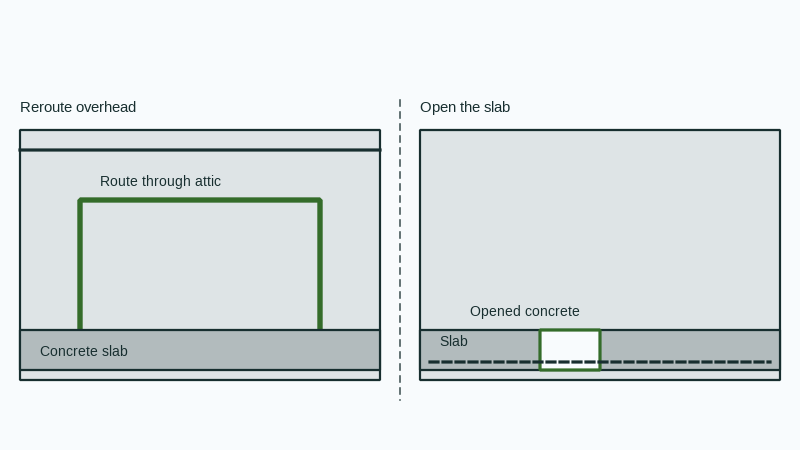
Many tract homes in Simi Valley built between the 1960s and 1990s sit on slabs, with supply lines in the slab or the attic depending on the builder. When a slab line leaks, the plumber first pinpoints the leak. If only one line failed, the fix may be rerouting that single line instead of a full repipe. The page on choosing between a slab leak fix and a repipe shows how that decision is made.
How is a repipe done with PEX?
This flexible plastic tubing, PEX, bends around corners, which lets the plumber pull long runs through walls with fewer cuts and joints than rigid pipe requires. Fewer joints mean fewer places for later leaks. Crimp or expansion fittings connect it to manifold boxes or traditional tees.
Repipers favor PEX because it damages walls less and usually goes in faster than soldered copper. It tolerates freezing better than copper does, although Simi Valley rarely sees hard freezes. It cannot run outdoors in sunlight, and the plumber still has to join copper or other metal at the water heater and main. When you are picking a material, our comparison of PEX and copper pipe sets out the trade-offs.
What determines the price of a repipe?
Prices follow the house, not a single flat rate. The main factors are how many bathrooms and fixtures there are, the number of stories, how easily the walls open, the pipe material, whether a slab complicates access, and which party obtains the permit. A PEX job commonly costs less than the same house in copper, and bigger houses cost more.
No dollar figure appears on this page, because a number without a source is a guess. Gather at least two written quotes with the scope spelled out: how many fixtures, what material, which wall repairs are included, and whether the permit is in the price. The repiping price guide explains how to compare them, including the per-square-foot and per-bathroom ways quotes are sometimes framed.
At what point should I ask a local plumber for a repipe quote?
Begin asking if pipes leak in more than one place, if water turns brown or tastes metallic, if pressure drops across the whole house, or if the pipe material has a record of failing, such as polybutylene or old galvanized steel. A single pinhole in copper does not by itself call for a repipe.
If you are weighing it up, read about replacing galvanized pipe and swapping out polybutylene pipe, the two materials people most often replace outright. Then fill in the quote form with the house's age, the bathroom count and, if you know it, the pipe material; we forward your request to a local plumbing business that will give you a quote. Other jobs are listed on the home page.
Common questions
What is the typical duration of a whole-house repipe?
For an average single-story house, a repipe often takes a few working days, counting the inspection and drywall patching. Larger two-story houses, slab foundations and houses with finished walls that need careful access take longer. The quote carries a schedule, and normal water service is interrupted for part of each day.
Which questions belong on my list for a repiping contractor?
Request a written scope: material, fixture count, permit, wall repair, and cleanup. Ask who obtains the permit, whether you can verify the contractor's California license, and what warranty covers labor. California caps a deposit at the lesser of $1,000 or 10 percent of the contract price, so be wary of larger requests.
Must I be home while the house is repiped?
Typically someone should be present on the first day to walk the plumber through the house and on the last day to approve the work, and reachable for questions in between. Many families go to work and leave a key. Beforehand, move furniture and valuables away from the walls, and expect dust and noise.
What is the most economical way to repipe a house?
Usually PEX with a simple layout and easy access, never a shortcut on permits or testing. Cutting corners tends to cost more later in drywall and flooring repairs. Compare two or three itemized quotes, ask what is excluded, and ask whether a partial repipe of only the failing section suits your pipes.
Does repiping reduce my water bill?
It can if the old pipes were leaking, since hidden leaks waste water every month. Per the EPA, the typical home loses more than 9,300 gallons of water annually to leaks. A repipe will not reduce usage on its own, and it does not change your supplier's rates.