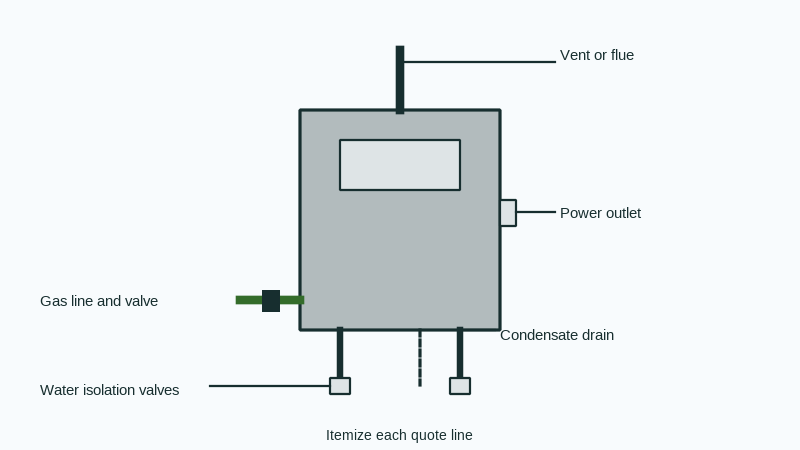
Installing a tankless heater costs more than swapping a tank, and the gap comes mostly from the work around the unit, not the unit itself. No checked, published local price turned up that we could quote, so no dollar figures appear here. What follows is what a quote should contain, so the numbers you receive can be compared fairly.
This page belongs alongside the guide to repairing and replacing a water heater. Exchanging one tankless unit for another is handled on the tankless replacement cost page.
What does a fully installed tankless heater add up to?
The total is the unit plus everything needed to connect it: gas pipe, vent, water fittings, permit and labor. The unit alone is only part. Expect installed prices to vary widely between homes, since a garage with a short gas run is a simpler job than a closet needing a new vent through the roof.
Treat any single figure from a website as an average of very different houses. A quote for your house should say what is in it. The main parts of an installed price:
| Line item | What it covers |
|---|---|
| The unit | Brand, model, fuel, and the UEF on its label |
| Gas pipe | A larger line and shut-off valve if the old one is undersized |
| Venting | Flue pipe, wall or roof penetration, condensate drain for condensing models |
| Water side | Isolation valves for flushing, new connectors, pressure relief valve and discharge pipe |
| Expansion tank | Often needed in a closed water system |
| Electrical | A power outlet for the unit's fan and controls |
| Permit and inspection | Through the city building office |
| Labor and haul-away | Time on site, old heater removal |
For an electric tankless unit, swap gas pipe and venting for a heavy-duty circuit and possibly a panel upgrade.
What do anode rods, valves and elements run to replace?
These parts are small, so they cost far less than a heater, though a plumber still charges for a visit and a minimum. An anode rod, relief valve, gas valve, thermocouple or heating element each has its own page here. The parts are cheap, so labor plus a minimum charge usually makes up most of the bill.
A short guide to what each part does, and when it matters:
- Anode rod. A metal rod that gives itself up to corrosion before the tank does. A fresh one can add years to a tank. See anode rod replacement.
- Relief valve. A safety valve that opens to vent when the tank gets too hot or too pressurized. See relief valve replacement.
- Heating element. Electric tank heaters carry two. If one fails, the water turns lukewarm. See element replacement.
- Thermocouple. A flame safety sensor on older gas tanks. See thermocouple replacement.
- Gas valve. A failed gas valve is a bigger repair, and on an older tank can approach the price of a new tank.
If a repair bill nears the cost of a new heater, ask for both figures in writing. A tank in its last years is a poor place to sink money into parts.
Why does tankless installation cost more than a tank swap?
Venting, the gas line and mounting. A tank usually goes in the old one's spot, reusing the old connections. A tankless unit hangs on the wall and often needs a new vent path, a larger gas supply and a place for condensate to drain. Each adds material and labor.
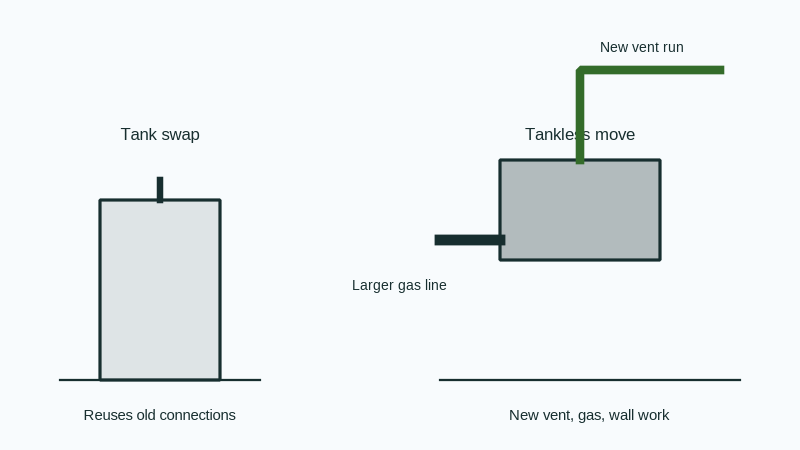
Typical reasons a Simi Valley quote climbs:
- Moving the heater. A heater moved from a closet to an exterior wall needs new pipes.
- Gas line size. Per hour, a tankless burner uses more gas than a tank heater, so the line may need upsizing. Gas piping is contractor work, and a permit with inspection is normally required.
- Vent run. Long or awkward vent routes cost more, and some models need stainless or plastic pipe depending on type.
- Older homes. Tight closets in older small lots near Old Town Simi limit where a unit can go.
- Wall repair. Patching and painting after the old heater comes out is often not included.
ENERGY STAR lists a minimum UEF of 0.95 for gas tankless models and requires at least 2.8 gallons per minute at a 67 degree rise. Those numbers show what the rating means. They are not a statement about any particular model sold locally.
What do plumbers usually charge to swap a water heater?
No single average fits every house. Labor depends on the fuel, tank size, access, and whether the permit, expansion tank and new valves are included. Replacing a tank with a tank is the cheapest case. Changing fuel or type adds work.
Ask the plumber to separate labor from parts, so you can see which portion is time and which is material. A quote showing one lump sum is hard to compare. Tank swaps are covered in water heater replacement cost, and the common size is examined in the one for a 50 gallon tank.
A 40 gallon unit follows the same logic as a 50 gallon one: the price gap between sizes is often small next to labor, venting and permit. Hot water heater replacement cost walks through it.
How do I make sure a tankless quote is fair?
Collect at least two written quotes from different plumbing businesses and give each the same facts: current heater type and location, fuel, number of bathrooms, and the model you want or are open to. Quotes covering the same lines can be compared. Ask each to list the permit, venting and gas line separately.
What to include in your request on the quote form:
- Photos of the current heater and the wall around it.
- The fuel type, gas or electric.
- Whether you want the heater to stay where it is.
- Anything you have already bought.
We forward the request to a local plumbing business, which pays us a fee for taking it. Before accepting a quote, look up the contractor license on the CSLB website, and ask how the permit is handled. Free estimates are common for replacement jobs but not for every visit, so ask whether a visit is charged when you request one.
What else can push the cost up?
Hard water is one cause. Check the yearly water quality report issued by your district. Scale inside a tankless unit needs descaling, and some owners add a softener. Another is code upgrades the plumber discovers on the day, such as a missing seismic strap, a gas shut-off, or a non-compliant relief valve line, each of which adds items to the bill.
Ask in advance whether the plumber expects any code work, and get the reply in writing. For later service, the Rinnai repair page and the gas tankless installation page show what upkeep looks like.
Is a permit required to install a tankless heater?
Swapping a water heater generally means a permit and inspection through the city building office, and new gas piping or venting is covered by that. Confirm with City of Simi Valley Building & Safety Division or City of Moorpark Building & Safety, as listed on their sites, before work begins.
The permit works in your favor, because an inspector checks gas connections, the vent and the relief valve discharge. It is one more line on the quote. A plumber claiming no permit is required for a gas tankless install deserves a second question and a call to the building office.
Common questions
How long does a tankless install take on site?
Typically a full day for a gas unit when the vent and gas line change, sometimes longer if the permit inspection falls on another day. Exchanging a tankless unit for another can go faster. The plumber should state an expected duration and say if the inspection needs a second visit.
What should I ask before hiring for a tankless install?
Request a written quote listing the unit, gas line, venting, permit, labor and haul-away. Find out who obtains the permit and whether a visit is charged. Verify the contractor license number on the CSLB site, and learn what the manufacturer warranty covers and who handles claims.
Is a no-charge estimate available for a heater job?
Many businesses give free estimates on replacement work and charge for repair diagnosis visits, though practice varies. When you send the request, ask if the estimate visit is free, if it is credited against the job, and if the estimate is written and binding for a stated period.
Does a tankless heater require bigger gas piping?
Often yes, since it burns far more gas per hour than a tank. The plumber has to check the size and length of your existing line. Upsizing is gas work done by a contractor under permit. If gas is ever in the air, leave the building and reach your gas utility from outside.