Does your gas water heater's pilot light up, then die the moment you release the knob? The thermocouple is the first suspect. The part is cheap, yet it works alongside gas, so this page begins with safety and ends at the point where you hand the work to a local plumber. For the wider picture on repairs, read the water heater repair guide. The home page shows every other service we cover in Simi Valley and Moorpark.
How does a thermocouple work in a gas water heater?
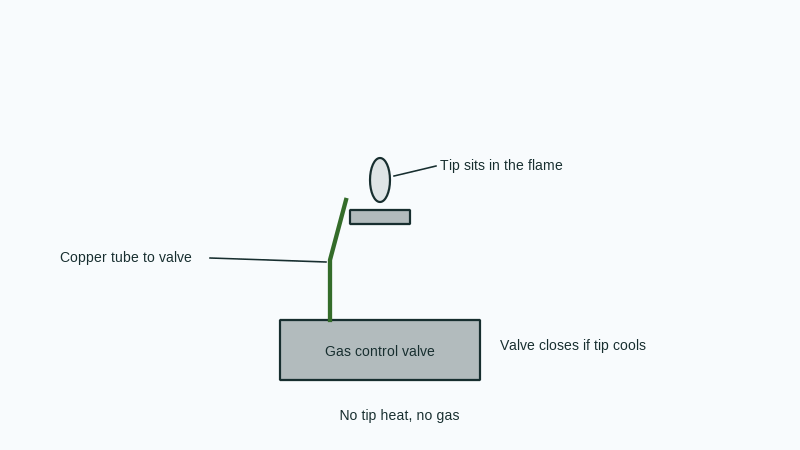
The thermocouple is a flame safety sensor. Its tip sits in the pilot flame, producing a tiny voltage that keeps the gas valve open. Should the pilot go out, the tip cools, voltage falls, and the valve closes, so raw gas cannot stream into the room. For the same reason, a bad sensor leaves the pilot unable to stay lit.
On a typical older tank heater it is a thin copper tube running from the gas control valve at the bottom up to the pilot assembly. The tip is clamped next to the pilot burner. Over the years the tip can corrode or pick up soot, and it then makes too little voltage to hold the valve open.
No outside electricity feeds this circuit, which is why standing-pilot water heaters can keep working during a power cut. It also means a failed sensor is a purely mechanical, gas-side problem, and resetting a breaker will not fix it.
Is it worth replacing the thermocouple or the whole heater?
Replace the thermocouple if the heater is otherwise sound, and weigh a new heater if the old one is aged, corroded or leaking. A rusted tank or a leak cannot be cured with a small part. Give the plumber the heater's age, and set the repair figure against what a new unit would cost.
Signs pointing toward replacement include rust-colored hot water, moisture around the base, a rumble from sediment, and repeated repairs in a short span. Our guides on anode rod replacement and water heater replacement cost help you weigh the choice.
Should you choose a new heater, the next stop is plumber help with water heater replacement. California adds bracing and venting rules to a full replacement, which a plumber knows, and the Building and Safety office of your city can explain what applies.
How can I tell the thermocouple has failed?
The classic symptom is a pilot that burns while you hold the control knob down, then dies seconds after you let up. No hot water follows, and the heater stays cold. A dirty pilot tube, a draft, or a gas control valve in poor shape can behave the same way, so a failed thermocouple is the likely cause, not the only one.

Watch the pilot flame while it burns. A healthy flame is mostly blue and wraps around the thermocouple tip. A weak, flickering or yellow flame suggests a dirty pilot, a draft or a gas supply problem, and a new thermocouple will not cure it. Soot on the heater or around the draft hood is a warning sign: stop, do not relight, and have a plumber look.
If the pilot stays lit yet no hot water arrives, the thermocouple is not to blame. Other causes, such as a cracked dip tube or a burned-out element on an electric unit, are covered in reasons for no hot water and a heater that runs but gives no hot water.
Is changing a thermocouple a DIY job?
Some owners handle it on older standing-pilot heaters, because the part is compact and threads out of the gas control. Even so, it sits next to gas fittings, and gas piping work belongs to a contractor. If you cannot confirm the burner is off and the gas valve closed, or cannot follow the manual, leave it to a local plumber.
Exact steps live in your heater's manual and vary by model. In outline: set the control to off, close the gas shut-off, let everything cool, unscrew the old thermocouple from the gas control and the pilot bracket, fit its replacement in the same position, then relight following the manual. Do not force any fitting, and never search for a leak with a flame.
Afterward, brush soapy water onto the joint you touched: bubbles mean a leak. If you see any, shut the gas and contact a plumber. Anything involving the gas supply line, the shut-off valve, or the valve that controls the gas needs a contractor. How those jobs are priced is shown in the guide on gas line pricing.
A carbon monoxide alarm near gas appliances is a sensible precaution whatever the repair, and so is clearing stored belongings from around the heater.
When should a plumber step in?
Bring in a local plumber when a new thermocouple still leaves the pilot dying, when you can smell gas, when soot or a yellow flame appears, or when the heater is getting old. A full heater replacement typically needs a permit, and the Building and Safety office of your city can say whether one applies. The quote form is how we pass the request along to a local plumbing business.
Describe the symptom, give the brand and model if the label is readable, and say whether the pilot lights at all. A clear description lets the plumber bring the right parts. Send it with the quote form, and a local plumber will set up a visit. Weekday requests get read from 9am to 5pm. Before work begins, the plumber provides a written quote. The page on hot water heater repair covers the broader job of fixing a heater.
What should I do if I smell gas near the heater?
Smelling gas is a signal to get out right away. SoCalGas advises evacuating immediately and then contacting 1-800-427-2200 from somewhere safe, or 911 in case of danger or when the gas company cannot be reached. Strike no flame, operate no switches, and never attempt a repair on the pipe or meter.
SoCalGas also advises against trusting smell alone, since odor can fade or go unnoticed. Listen for hissing or whistling near a gas line or appliance. Those numbers serve homes with SoCalGas service; where another provider supplies your street, its number appears on your gas bill.
After a gas smell, leave the pilot alone until the gas utility or a plumber has inspected the heater. A heater that loses its flame and then fills the space with gas is exactly what the thermocouple exists to prevent, so a smell near the heater is never a reason to keep trying.
If an earthquake triggers the emergency, read about shutting off the gas after a quake.
Do tankless water heaters use a thermocouple?
Some do. Wikipedia notes that certain tankless water heaters use a thermocouple as a cutoff when gas fails to ignite or the flame goes out. Some modern units rely on electronic ignition and a flame sensor instead, so check the model's manual before buying a part. A plumber can identify the correct sensor from the model number.
On a tankless unit, a flame fault tends to show as a code on the display instead of a dead pilot. The manual's code table says whether it is an ignition, sensor or venting problem. Do not buy a sensor on a hunch: a wrong part wastes money, and some faults stem from a blocked vent or low gas pressure, not the sensor.
Common questions
What is the time needed to replace a thermocouple?
With the correct part in the van, a plumber often needs only a short visit, though relighting and testing add time. Heaters with scale, rust or cramped access take longer. The plumber supplies a time guide on the day. Our form makes no promise about response times.
Which questions should I raise before booking a pilot repair?
Ask whether the quote includes the part and a gas leak check, what happens next if the new thermocouple fails to solve the problem, and whether the heater's age makes replacement worth discussing. Have the price put in writing, and look up the contractor's license on the California Contractors State License Board website.
Must an adult be home for the pilot repair?
Yes. An adult should be present when the plumber starts, to point out the heater and agree the scope, and again at the end to watch it run. Clear the area around the heater, so the plumber has access to the controls and the gas shut-off.
Is it safe to keep relighting the pilot?
Relighting again and again without finding the cause is unwise. If the pilot dies every time, the safety system is working as designed, and something is wrong: the thermocouple, a draft, a dirty pilot or the gas valve. If you ever smell gas, stop and follow the SoCalGas steps given earlier.