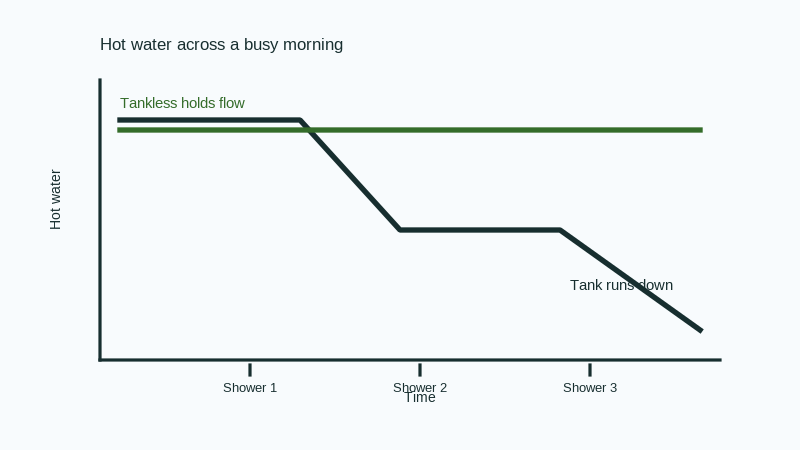
A gas tankless heater serves households that want endless hot water and have the wall space and gas supply for it. A gas tank serves homes that want to pay less up front and swap the unit with little fuss. Three facts decide: your gas line, your vent route and how many hot taps run at one moment. The repair side of both is in the wider water heater repair guide.
Which gas heater is right for the people in my home?
Match the heater to the pattern of hot water use. A large family with showers back to back gains the most from tankless, since there is no stored volume to drain. A couple or single person using little hot water may gain little. A small guest unit often suits a compact tank or a small tankless model.
A scenario guide:
| Household | Likely fit | Why |
|---|---|---|
| Family of five, morning rush | Tankless, if gas line allows | Nothing stored to run out |
| Couple, light use | Tank is fine | Tankless savings are small |
| Home with a soaking tub | Large tank or high-output tankless | Tubs pull a lot at once |
| Guest house or accessory unit | Small tank or compact tankless | Low and irregular use |
| Rental you do not live in | Tank | Lower first cost, familiar to every plumber |
If you are unsure, ask for both options in your quote request to see the real price gap for your house.
What energy saving can I expect from tankless gas against a tank?
It saves the energy a tank loses keeping water hot all day, and the saving peaks in homes using little hot water. The saving narrows with heavy usage, because a busy tank loses less to standing. Compare the Uniform Energy Factor on each label and apply it to your own use.
ENERGY STAR sets a minimum UEF of 0.95 for gas tankless models. For gas storage tanks over 20 and up to 55 gallons its minimum is 0.81 at medium draw and 0.86 at high draw. A higher number is better. The gap between 0.95 and 0.81 is real, but it applies to the energy the heater uses, not to the entire gas bill, since your furnace and stove draw from the same meter.
To size up the saving yourself:
- Find the yearly gas use for water heating. If your bill does not separate it, ask the gas utility for a usage history.
- Estimate how much of that the better rating would cut.
- Set that against the extra installed price of tankless.
- Do not bank on the best case, since a household running hot water for long periods narrows the gap.
Older articles often quote an earlier Energy Factor scale, so their numbers do not line up with the UEF on today's label.
Is switching from a tank to gas tankless worth it?
It pays off when you will stay long enough for savings to cover the extra price, when hot water demand is high, or when your tank is failing and replacement was coming anyway. It does not pay off if the work needed is very large or you will move soon.
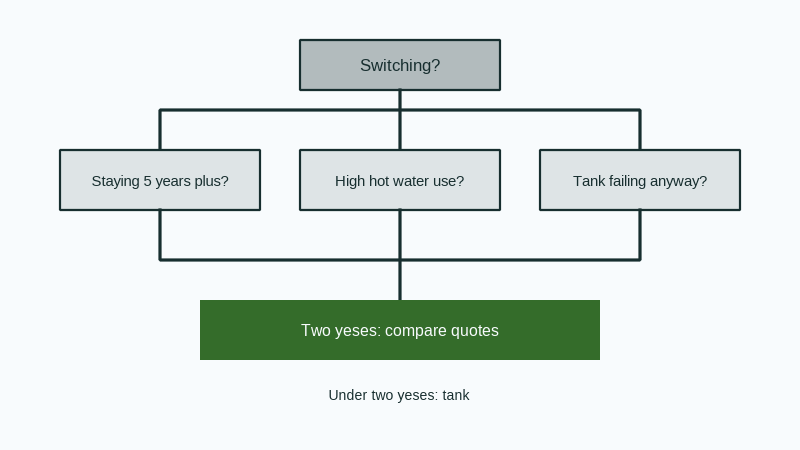
The honest answer turns on the quote. If the install needs fresh gas piping, a new vent through the roof and a wall repair, the extra price grows. If the heater moves only a short way and the gas pipe is already large, the extra shrinks. For the cost items, read tankless installation cost. The page on gas tankless installation describes the job itself.
A mix of benefits can tip the choice:
- You will have more guests or a new bathroom.
- You want to free floor space.
- Your tank is old and a leak could damage the house.
For many Simi Valley homes, replacing a tank with another tank is still the right choice, especially where the heater sits in the garage and the existing gas pipe is modest.
What are the advantages and drawbacks of gas tankless?
The advantages are no standby loss, no stored-water limit, a compact wall-mounted size and a long service life when maintained. The drawbacks are a higher purchase and install price, a cap on flow when several fixtures run, the likely need for bigger gas piping and a dedicated vent, and regular descaling in hard water.
Pros:
- Hot water without a stored limit.
- Frees floor space in a garage or closet.
- Can be a good match for a high-use home.
Cons:
- Higher installed price, mostly from venting and gas pipe changes.
- A delay of a few seconds before hot water arrives, plus the pipe run.
- Cold water pockets in some usage patterns when taps are opened lightly.
- Needs power for fan and controls, so a power outage stops it.
- Upkeep: flushing and filter cleaning.
Tank pros and cons are the mirror image: a lower price and simple swap, but standby loss, bulk, and the chance of running out. A failed tank can release its whole volume into a garage, which counts in favor of a unit with no stored water.
What does gas tankless demand that a tank skips?
It requires a gas pipe sized for a high burner rating, a vent able to handle its exhaust, a power outlet, a condensate drain for condensing models, and wall space. Meeting those requirements is why a tankless install costs more than a tank swap, and why a permit and inspection matter.
The details:
- Gas supply. A tankless burner can burn several times the gas per hour of a tank burner. The existing pipe must be checked and may be upsized. Gas piping is contractor work, with a permit through the city building office.
- Venting. Condensing models vent through plastic pipe, and non-condensing models use metal flue. The manufacturer's rules limit the route and the length.
- Water. Isolation valves, so the unit can be flushed.
- Power. A nearby outlet.
- Location. Outside, inside a garage, or in a closet, each with different clearances.
If you ever smell gas, leave the building, reach your gas utility once outdoors (the number is on your bill), and note that 911 is for anyone at risk. Do not try to find the leak yourself.
How long do tankless and tank gas heaters typically last?
Service life depends on water quality and upkeep more than on type. Tanks often wear out from corrosion and sediment, and tankless units wear from scale and heavy use. No verified figure for local lifespans exists here, so ask the plumber and read the warranty. ENERGY STAR lists a six year warranty on the heat exchanger of a gas tankless unit and six years on a gas storage system as minimums.
Warranty length is not lifespan, but it shows what makers stand behind. Check what the warranty excludes, such as damage from scale, and whether labor is covered, since that varies by maker.
To extend life:
- Flush a tank every year to clear sediment, and check the anode rod that shields the tank. See anode rod replacement.
- Descale a tankless unit on the schedule in its manual.
- Read your district's yearly water quality report for hardness. Ventura County Waterworks District No. 8 serves most of Simi Valley, Golden State Water serves the eastern end, and Ventura County Waterworks District No. 1 serves Moorpark.
The page on water heater lifespan and replacement timing covers signs of age.
Common questions
Do gas tankless units outlast tanks?
They can, with regular descaling, since there is no tank to corrode. Hard water can shorten a tankless unit's life if it is not flushed, though. Check the manufacturer's warranty and ask the plumber what has been typical locally for your water supply.
What should I put to a plumber about a gas heater swap?
Learn whether the quote covers the gas line check, venting, permit, expansion tank and haul-away. Ask how the plumber will size the gas pipe. Verify the contractor license number at the CSLB website, and have the quote in writing ahead of the work.
Does a tankless unit still heat in a blackout?
Usually not, since the fan and controls need electricity, although the burner runs on gas. A tank with a standing pilot or a simple control may still heat. If outages worry you, ask the plumber about a battery backup option for the model you choose.
Is a gas tank cheaper to run than electric?
That depends on your gas and electric rates and on the heater's efficiency. Compare the cost per unit of energy and the UEF of each model, not just the sticker price. Ask your utilities for current rates and any rebates, and do not assume a rebate exists until they confirm it.