Inside a dripping faucet, a rubber or ceramic part has worn out, and the faucet's design decides which one. Swap that part and the drip stops, with no need to buy a new faucet. Below you will find the four designs, the tools, the repair itself, and the warning signs that call for a plumber. Related jobs sit together in the group of pages on sinks, faucets, showers and disposals. When the job turns out bigger than a quick swap, you can send us a request. We forward it to a Simi Valley or Moorpark plumbing company, and we earn a fee from whichever business accepts it.
Why does my faucet leak, and how do I know what type I have?
Leaks typically start with a worn seat, a hardened washer, a cracked O-ring or a failing cartridge. Most faucets in homes today belong to one of four families: compression with two handles, cartridge, ball, or ceramic disc. Removing the handle reveals the inside. Twin handles that screw down mean compression; one handle that lifts and pivots sideways means cartridge, ball or disc.
How to tell:
- Compression: two handles, which you tighten to stop the flow. Washers and seats wear out. Usually the oldest design.
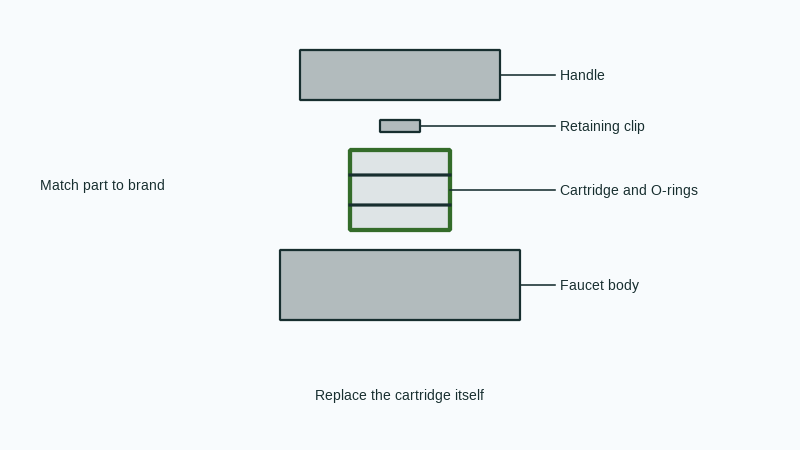
- Cartridge: one or two handles that move smoothly. A plastic or brass cartridge with O-rings sits inside. Many Moen and similar single-handle faucets are cartridge types.
- Ball: a single handle over a ball joint, common in some kitchen faucets. It has springs, seats and a cam.
- Ceramic disc: a single handle on a wide cylinder; two ceramic discs inside. Durable, and the usual fault is the seals.
Find the brand stamped on the faucet or its underside; the manufacturer's website lists parts and often shows an exploded diagram. Sizes vary, so bring the worn piece with you to the store when you shop for its match.
The EPA puts the yearly loss for a typical household at more than 9,300 gallons of water through leaks, and a dripping faucet adds to that waste, so do not put the repair off.
What tools and prep does the job need?
You need only basic gear: an adjustable wrench, screwdrivers, Allen keys, pliers, a cup for loose screws, a rag, plumber's grease, and new parts that fit your particular faucet. Plug the drain with the rag so tiny screws cannot drop in. Keep every old part nearby for side-by-side comparison with the new ones.
Under the sink, turn each valve clockwise until it stops, then open the faucet to release pressure. If the shutoffs refuse to close, shut the main valve for the house instead. Photograph each step while taking things apart so you can retrace it. Plenty of handles hide a screw under a cap or decorative button, which you can pry up gently with a small knife.
Should any valve refuse to turn or start leaking as you move it, stop, since forcing an old valve can cause a bigger leak. Our page on tracing a leak below the sink deals with valves and supply lines.
At what point should a plumber take over the job?
Call in a pro when water escapes from a valve body inside the wall, the shutoffs will not close, corrosion has frozen the parts, your repair failed to end the drip, or the faucet is old enough that a new one is the smarter buy. The same visit can cover replacing the faucet and its supply lines.
California rules generally require a contractor license for any job where labor plus materials come to $1,000 or more. A faucet repair usually costs far less, yet it still pays to check the contractor's license number at cslb.ca.gov and get a written quote. A deposit cannot exceed $1,000 or 10 percent of the contract price, whichever is lower.
Hard water accelerates wear and scale buildup. We have not verified a hardness figure for any Simi Valley supplier, so consult your water district's annual report. A vinegar soak removes scale from an aerator; the page on preventing hard water scale has more.
How do I fix a compression faucet or a shower faucet?
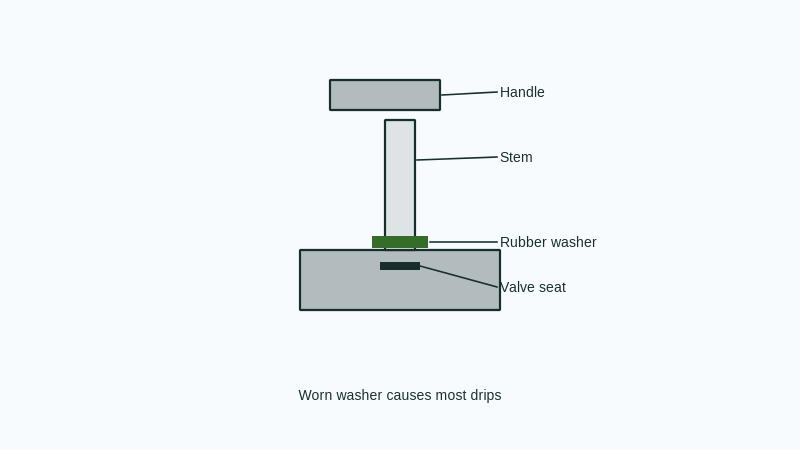
For a compression faucet, shut off the water first, then unscrew the handle and lift out the stem. At the bottom of that stem is a rubber washer; replace it, and if the seat below looks pitted, either smooth it or swap it. Showers work on a similar principle. Behind the handle and trim plate lies the stem or cartridge, so stop the water, then renew the cartridge or the washer and seals.
Showers are harder. Shutting the water off may mean going to the water heater or the main, and the valve body sits buried inside the wall. With no access panel and no way to reach the valve, stop there and request a plumber. For the cartridge case in detail, read the guide on a leaky shower faucet.
Water that runs from the showerhead once the valve is off often points to a worn cartridge or seat in the valve. A shower leak that stains a wall or ceiling may be hiding behind the wall, and that needs a plumber. See also leaking pipe repair if you notice staining.
How do I repair a one-handle kitchen faucet or a Moen bathroom faucet?
Shut off the supply, then remove the handle and whatever retaining clip or nut keeps the cartridge in place. Extract the old cartridge and insert a matching new one whose O-rings are greased. Reassemble in reverse order, then restore the water slowly and watch for drips. Moen and other brands make cartridge faucets, the most common one-handle design.
Steps for a cartridge faucet:
- Pry off the cap and undo the handle screw.
- Remove the handle, plus any trim collar beneath it.
- Pull the retaining clip or nut free. On certain Moen models the clip simply slides out.
- Draw the cartridge straight upward and note how it sits; a mark or flat edge must line up again later.
- Insert the new cartridge pointing the same direction, coat its O-rings with plumber's grease, and refit the clip and handle.
A ball faucet repair kit holds springs, seats and a cam. With a ceramic disc, change the cartridge or the seals. Always match the part to the brand and model number, as generic parts may not fit.
Water seeping around the spout base instead of from its tip points to the spout O-rings; lift off the spout, replace the O-rings and grease them.
Common questions
How much time does a faucet repair take?
A plumber can often change a washer or cartridge in 30 to 60 minutes, while a first-time DIY attempt runs longer. Shower valves and seized faucets need more time still. After inspecting the faucet, the plumber gives an estimate along with the written quote.
Which questions are worth asking before a faucet repair is booked?
Ask for a written quote that itemizes parts and labor separately, and get the contractor license number so you can verify it with the state licensing board online. Also ask if new supply lines or shutoff valves are included should they fail, and have the warranty on the repair put in writing.
Does an adult have to be at home during the repair?
Yes, an adult should be there so the plumber can reach the sink, turn off the water and test the faucet afterward. Clear out the cabinet below before the visit. When nobody can be present, raise that when the plumber reaches out to schedule.
Is it better to fix or swap a dripping faucet?
Fixing makes sense when the culprit is an O-ring, washer or cartridge and the body is in good shape. Choose replacement when parts are no longer made, the finish has worn off or the body is corroded. Have the plumber price both options. More topics are in our other guides.
Why does my faucet drip even with a fresh washer?
Three causes are likely: a pitted valve seat, a damaged stem, or a washer in the wrong size. Smoothing a rough seat takes a seat dressing tool, or the seat can simply be replaced. When dripping continues after a careful job, a plumber can examine the valve body.