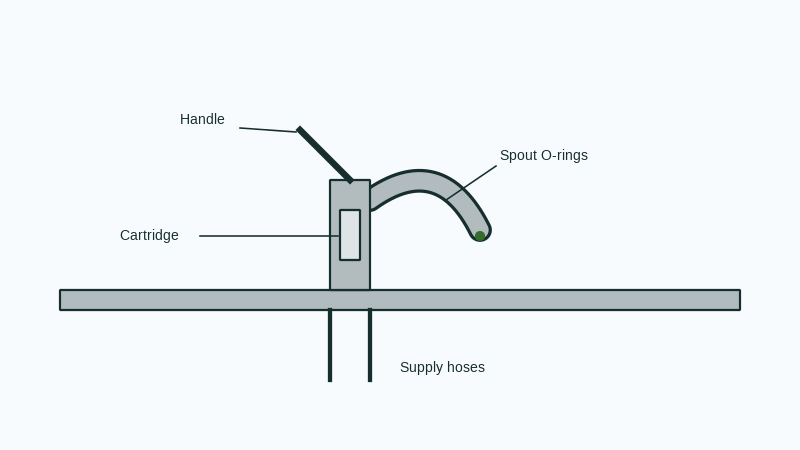
A worn part inside is behind most kitchen faucet leaks: a cartridge, a ceramic disc, a rubber washer or an O-ring. The repair takes a few parts and a screwdriver, and under an hour. Disposals and drains share the sink area, so when the leak sits beneath the counter, the nearby garbage disposal repair page may help.
Where in the kitchen faucet is the water escaping?
The spot where moisture first appears points to the failing part. A drip from the spout implicates the cartridge, disc or washer. Dampness near the handle's foot suggests a worn seal ring or the packing nut. Wetness at the spout's base comes from the spout O-rings, and water inside the cabinet comes from supply hoses, shutoffs or the faucet's mounting connections.
Dry the faucet, then keep an eye on it. Lay a paper towel under the spout and another inside the cabinet. Run the faucet, shut it off and note where the first drop lands. A drip that stops once you press the handle firmly shut almost always means the cartridge. A leak that shows only while water runs suggests O-rings or a cracked body.
What tools and replacement parts should I gather?
Collect a screwdriver set, an adjustable wrench, an Allen key, plumber's grease, a towel, and a replacement cartridge or repair kit made for your faucet's make and model. Bring the old part along to the hardware store, or photograph the faucet label and look up the model before you buy.
Faucet types differ. A single-handle faucet holds a cartridge or ball, whereas a two-handle model uses a stem fitted with a washer, or a ceramic disc. Pull-down sprayers add a hose and a weight. Before starting, turn off the valves under the sink, then run the tap briefly so the pressure drops. Block the drain so tiny screws cannot disappear.
How do I repair a dripping one-lever kitchen faucet?
Close the shutoffs, pry off the handle cap, take out the handle screw and lift the handle off, unscrew the retaining nut, pull the cartridge, install an identical replacement, then reassemble and test. Lightly grease the new O-rings and note how the cartridge faces before removing the old one.
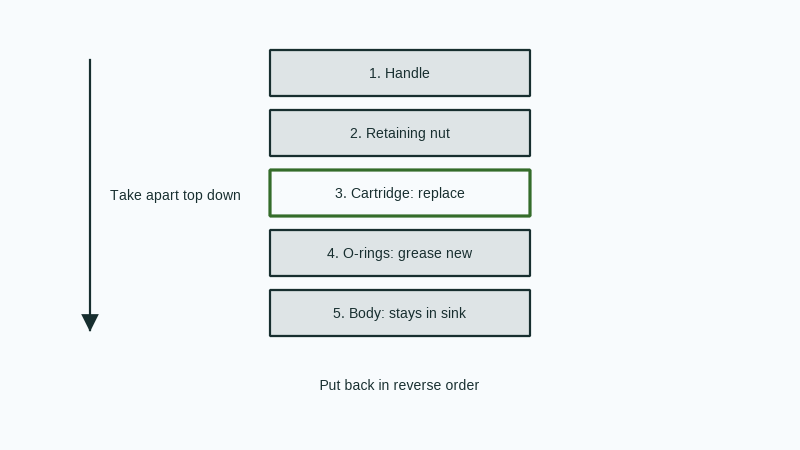
Some small habits prevent trouble. Arrange the parts in sequence on a towel, and photograph every stage. A few cartridges need a special puller. Never force the nut, because the brass body can crack. When putting it back together, open the faucet and bring the water on slowly, then check beneath the sink for drips. For other faults on this style, see the guide to single-lever faucet leaks.
How do I repair a dripping two-handle kitchen faucet?
Close the shutoffs, take off the handle, unscrew the packing nut and remove the stem. Put in a fresh rubber washer and O-ring, or a whole new stem when it contains a ceramic disc. Wipe the seat clean, reassemble and test. Change both sides when one is worn, as its partner is likely close behind.
A rough or pitted seat inside the faucet body stops a new washer sealing, so the drip carries on. A seat wrench or dressing tool will smooth a brass seat, and some seats can be swapped. With a corroded body, a new faucet makes more sense. The article on two-handle faucet drips has the details.
Why is the faucet leaking after I installed a new cartridge?
Usual culprits are a damaged seat, a cracked body, the wrong cartridge, an O-ring pinched during assembly, a loose retaining nut or mineral scale. Work through each one. Draw the cartridge out again and look for scoring on the metal, particularly where the water is rich in minerals.
Mineral buildup often causes repeat leaks. We have no confirmed hardness figure for Simi Valley or Moorpark, so read your water provider's annual quality report and compare it with white crust on your fixtures. The steps for clearing hard water deposits are on a page of their own. A vinegar soak helps loosen scale from the part.
Should the faucet be mended or swapped for a new one?
Mend a sound faucet when parts can be found. Swap it if the body has cracked or corroded, the finish is peeling, parts are discontinued, or it has needed repair more than once. A new faucet costs more than a cartridge, yet it can end a string of small repairs.
For a replacement, check how many holes the sink has and how long the supply lines are. Shutoffs that will not close and corroded supply lines should be changed in the same visit. Prices for a plumber doing the work appear under faucet replacement cost and install faucet cost.
Does a dripping faucet waste much water?
Yes. Over time a steady drip accumulates, stains the sink and may signal a part close to failing. Catching it early is cheap. A drip is rarely an emergency, but a leak inside the cabinet needs attention before it rots the cabinet floor.
Make a habit of looking in the cabinet below the sink every few months. A slow drip from a supply hose can run for weeks without showing. If you find a wet cabinet floor, close the shutoff valves and read about finding the source of a leak under the sink.
When should I bring in a plumber?
Call in a plumber if the shutoff valves will not close, the faucet body has cracked, pipes look corroded or the cabinet is wet, a part swap has not ended the drip, or the faucet is part of a sink replacement.
On the quote form, describe the faucet type, its brand if known, where it leaks and what you have tried. We pass the request to local plumbing businesses, and one replies with a price and time. The businesses that take requests pay us a fee. The form is read Monday to Friday, 9am to 5pm.
Common questions
How much time does fixing a dripping kitchen tap need?
For a first-timer, replacing a cartridge or washer typically takes under an hour, and less for a plumber. Allow longer if the shutoffs are stiff, parts must be ordered or the faucet proves corroded. A plumber can often complete the work in one short trip.
Which questions should I put to a plumber ahead of a faucet job?
Ask whether the price includes parts and labor, if shutoff valves and supply lines will be replaced when needed, how long the visit lasts, if the repair is covered should the drip return, and for the California contractor license number of the person coming, to verify on the CSLB site.
Must the water be shut off before a faucet repair?
Yes. Turn off the two valves beneath the sink, or the main if there are none, then run the tap to release pressure before taking anything apart. When a shutoff will not turn or leaks, stop and ask a plumber to swap it.
Why does my kitchen faucet drip only a little?
A slight drip usually means an early-stage worn washer or cartridge, or a little scale on the seat. It is a low-urgency fix but can worsen. Even a small drip wastes water over time, so repair it when convenient.