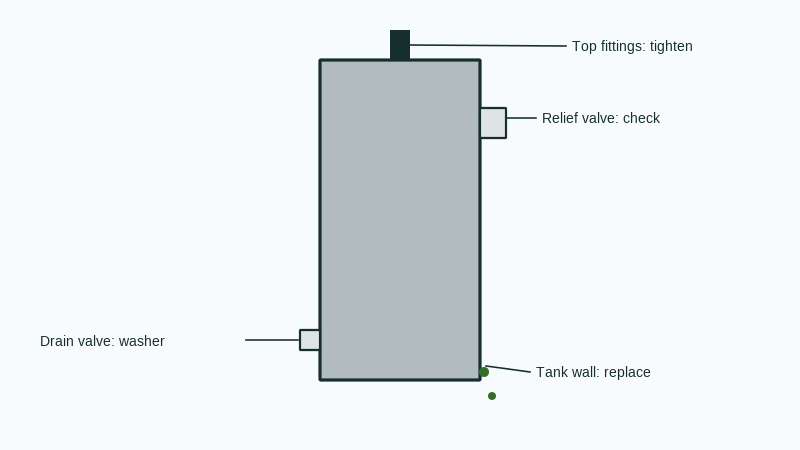
If the leak comes from a fitting, valve or gasket on an element, high on the tank or along its side, repair is possible. Water coming out of the base of the tank itself usually means replacement. Start with the water heater repair overview, then read on to work out which case applies.
Does the spot where my heater leaks matter?
It matters a great deal. Water at the pipe connections on top, at the T&P relief valve (temperature and pressure), or at a drain valve often traces to a part that can be tightened or replaced. Water pooling under the tank and seeping from the jacket signals a failed tank, which cannot be repaired.
Dry the area with a towel, then watch for the first new drop. Top connections: tighten or replace the fitting. Relief valve discharge pipe dripping: pressure or temperature is too high, and the valve may be worn. Drain valve at the base: usually a worn washer. Water from the lower jacket, with a rusty streak down the side: the tank has corroded through.
What about a leaking tankless water heater?
Tankless units leak from internal heat exchangers, fittings, condensate lines or the relief valve. A leak inside the unit usually means opening the cover and replacing parts, or retiring the unit. Brand matters: Rheem, Rinnai, Navien and Noritz each carry their own parts and error codes.
Condensing models drain acidic condensate through a small line. A blocked or loose condensate line shows up as a drip that resembles a leak. Check it before assuming the heat exchanger has failed. If you see scale in the unit, mineral buildup may be the cause, and a flush with the right kit slows it. For brand-specific pages, see Rheem tankless repair and Rinnai tankless repair.
How can I get a plumber to inspect it?
Complete the quote form with what you see, where the water comes from, how old the heater is if you know, the fuel it uses, and whether the water is off. Mark the request urgent if the tank is actively leaking. A photo of the leak helps too.
Your request reaches local plumbing businesses, and those that take requests pay us a fee. One replies with a price and a time, then a plumber visits. Reading of form requests happens on weekdays from 9am to 5pm. Beyond those hours, turning off the water and power is yours to do, and the plumber picks it up from there.
Is a leaking water heater fixable, or must it be replaced?
A leak at a fitting, valve, anode port, heating element gasket or drain valve can be repaired, often cheaply. Water escaping through the tank shell cannot be fixed: the steel liner is gone, so a new heater is the only cure. The tank's age and condition show whether to repair or replace.
When the tank is past its typical lifespan, a repair buying a few months may be unwise. The water heater lifespan guide gives the range. If the tank is young and a part is the trouble, repair makes sense. To weigh options, see replacement cost for what drives the price.
Which parts leak most, and how are they fixed?
Four parts cause most leaks: the T&P relief valve, the drain valve, the heating element gasket on electric tanks, and the supply connections. A plumber has a straightforward fix for each, though the relief valve and gas parts should not be a casual home job.
- Relief valve: replace the valve, and find out why pressure rose. See relief valve replacement.
- Expansion tank: a failed one can cause pressure spikes and valve leaks. See expansion tank replacement.
- Element gasket: replace the gasket or the heating element.
- Drain valve: replace the valve, or cap it after draining.
- Supply connectors: replace flex lines, check for corrosion at dielectric unions.
Which shutoff comes first?
Start with the cold supply valve on top of the heater, then cut the power or gas. For electric heaters, switch the breaker off. For gas, set the control to off or pilot. If water keeps flowing, close the main water valve for the whole house.
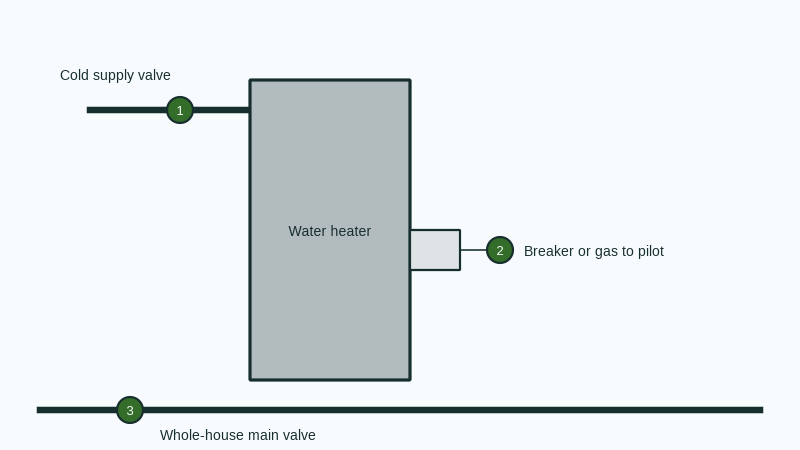
Never leave an electric heater powered with an empty or leaking tank, because exposed elements can burn out within minutes. On gas heaters, if you smell gas, leave the building, then report it to SoCalGas, 1-800-427-2200, from outside, or reach 911 when anyone is at risk. Avoid light switches on your way out.
A bucket and a wet-dry vacuum limit damage while you wait. Lift boxes off the floor. If the heater is in a garage, check that water is not running toward the gas appliance or the panel.
Is a permit or code work needed for a leaking heater?
A permit is generally required in California to replace a water heater, and the work must follow the plumbing code, covering seismic strapping, a T&P discharge pipe, a drain pan in some locations, and correct venting on gas units. Simple part repairs often do not need one. The Building and Safety office in your city makes that call.
Simi Valley issues permits via its Building and Safety Division, listed on the city website, while Moorpark uses its Building and Safety office at City Hall. Confirm with the office, and ask whether the plumber's quote includes the permit. For gas lines and venting, California requires a contractor to do the work. Tankless units have their own requirements, covered in gas tankless installation.
Common questions
Should a leaking water heater be treated as an emergency?
It is urgent, though not always dangerous. A slow drip at a fitting can wait a day if you set a bucket underneath. A steady flow from the tank can flood a garage fast, so shut off the water and power immediately. A gas smell or standing water near electrical items is a safety emergency.
How long does fixing a heater leak take?
Swapping a part is usually a short visit. Swapping the whole water heater typically takes a few hours when the new unit fits the same spot and the venting is in order. Moving the unit, upgrading the vent or adding a pan or expansion tank adds time.
Which questions should a leak plumber answer before I hire?
Find out if the plan is to repair or replace and why, what the written price includes, whether a permit and strapping are covered, how the old unit gets disposed of, and the California contractor license number. Check that number on the state CSLB site before work starts.
Should the plumber find the leak before I buy a new heater?
Yes. A leak that seems to come from the tank may be a pipe above or a condensation drip. Have the plumber confirm the source before quoting a replacement. A few minutes of checking can save the price of a unit you did not need.