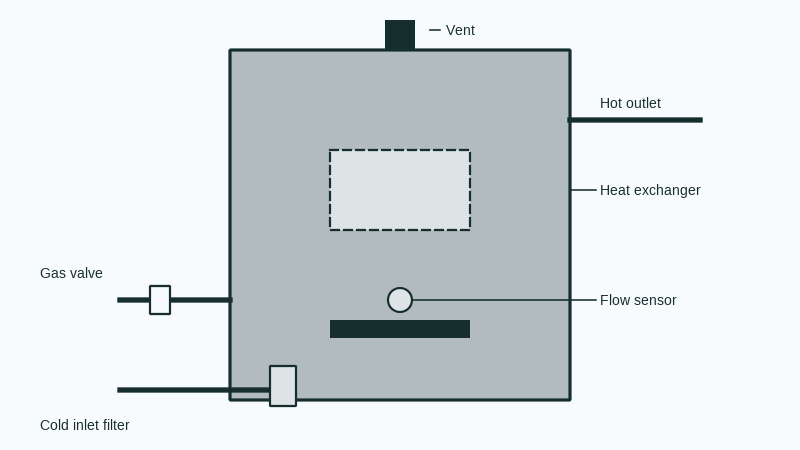
A Rheem tankless heater warms water only during a draw from an open tap, so its faults show up as lukewarm water, cold bursts, an error code or a unit that will not fire. An owner can safely do some of the checking. Gas, venting and internal repairs are off limits. The water heater repair hub covers other brands and the tank type.
What keeps my Rheem tankless unit from making hot water?
The usual suspects: a closed valve, a lack of power or gas, a clogged inlet filter, scale in the heat exchanger, or flow too low to switch the unit on. Begin with the easy items: is the display lit, is the gas valve open, and are the water valves fully open?
Open a hot tap all the way. Tankless units need a minimum flow before they ignite, and a faucet barely open may not trigger one. Hot water at some fixtures but not others can point to a cross-connection or a mixing valve elsewhere. The page on a unit that runs yet delivers no hot water explains that pattern.
How do I read the error codes?
Rheem displays codes for ignition, flame, vent, temperature sensor, flow and scale. The meaning of each code is printed in the unit's manual and on the sticker inside the cover, and it varies by model, so check yours instead of a generic list. The code tells a plumber where to start.
Write down the code and photograph it before resetting the unit. Many codes clear after a power reset and then come back, which signals a real fault. Note whether the code appears at the start of a draw, after a few minutes or only at certain flow rates. That timing helps narrow the fault.
Is flushing scale out of a tankless heater a DIY task?
Often, yes, by following the manufacturer's flush procedure, with a small pump, hoses and white vinegar or a descaling solution, as the manual directs. Flushing is routine maintenance, while removing the cover on the gas unit is not. Stop if valves are stuck or the water runs rusty.
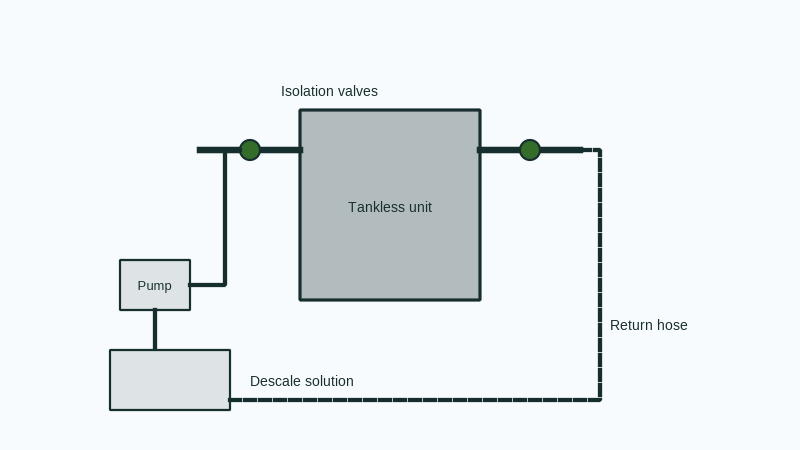
Scale forms wherever water is heated, narrows the heat exchanger and brings on error codes and temperature swings. Water hardness matters, and no confirmed figure is available for Simi Valley or Moorpark, so read your provider's yearly water quality report. Read about removing hard water scale and hard water scale prevention.
What should I know about the inlet filter and gas supply?
Many tankless units have a little screen at the cold inlet, and debris clogs it after plumbing work. Close the water valves, relieve the pressure, rinse the screen under running water and put it back. That is a normal owner task. The gas supply and gas valves are not.
If the unit throws ignition faults, a gas supply issue is possible: a closed valve, a low-volume line, or an undersized pipe. Gas piping is regulated work in California, so a contractor should alter it. If you smell gas, exit the house before anything else. Once outside, reach SoCalGas on 1-800-427-2200, and use 911 for emergencies. The gas tankless installation page covers gas line sizing.
When does a leak or noise signal a serious fault?
Water on the floor near a tankless unit may come from a loose fitting, a failed relief valve, a condensate line problem or a cracked heat exchanger. Rumbling or banging often means scale. A steady drip from inside the unit needs a plumber.
Shut off both the water and the gas feeding the unit, and disconnect power if you can reach it safely. Inspect the pipes and fittings under the unit, then the condensate line if yours is a condensing model. A cracked heat exchanger generally means a new unit, and a plumber can confirm whether that applies. Read water heater leak plumber.
Is it better to fix or swap out a Rheem tankless heater?
Fixing a fairly young unit is sensible when one part, such as the filter, fan, igniter or sensor, is at fault. Replacement is worth weighing after the heat exchanger fails, parts become hard to find, or the unit keeps needing repairs. Either way, the plumber should give a written reason.
Compare the repair price with what a new unit and installation would cost. See what a tankless water heater swap costs and installation cost for a tankless heater. The manual and warranty terms for your unit come from Rheem, and a plumber can read the serial number to establish its age.
Is a permit required for repair or replacement?
Repairing parts inside a unit generally needs none. Replacing a tankless heater, relocating it, or altering the gas line or vent usually does. In Simi Valley the Building and Safety Division handles permits, and in Moorpark the Building and Safety office does. Check with the plumber that the permit is part of the quote.
Venting is a safety matter. A badly sealed or sized new vent can let carbon monoxide into the house, so keep CO alarms working and never alter a vent yourself. Gas and vent work is a contractor's job, and any job that needs a permit in California also requires a contractor license.
What is the way to request a plumber visit?
Submit the form with the model and serial number from the label, the error code, what you tried and whether hot water works elsewhere. We pass the request to local plumbing businesses, the ones that take requests pay us a fee, and one replies with a price and visit time.
A person reads form requests from 9am to 5pm on weekdays. If the unit is leaking, close the water first. The overview of hot water heater repair and the page on other tankless brands may also help.
Common questions
What is the usual time for a Rheem tankless repair?
A cleaning, a flush or a sensor swap usually makes for a short visit. A fan, igniter or gas valve takes longer, and waiting on parts can mean a second trip. A plumber can estimate better with the model number and code in hand.
Which questions go to a plumber before a tankless repair?
Ask whether they work on Rheem units, what the visit fee includes, whether parts are priced separately, whether they can source Rheem parts, what warranty comes with the repair, whether a permit applies, and the California contractor license number they work under.
Does a tankless heater need a maintenance flush?
It is a good habit where the water is rich in minerals. Frequency depends on your water and use, and the manual gives the recommended interval. A plumber can set a schedule after examining your unit, and a softener reduces the need.
Is it fine to reset the unit?
Yes. Switch the power off for a minute, then on again. A one-off code may clear. If the same code returns, stop resetting. Write it down and ask a plumber, because repeated ignition attempts on a faulty gas unit are unwise.