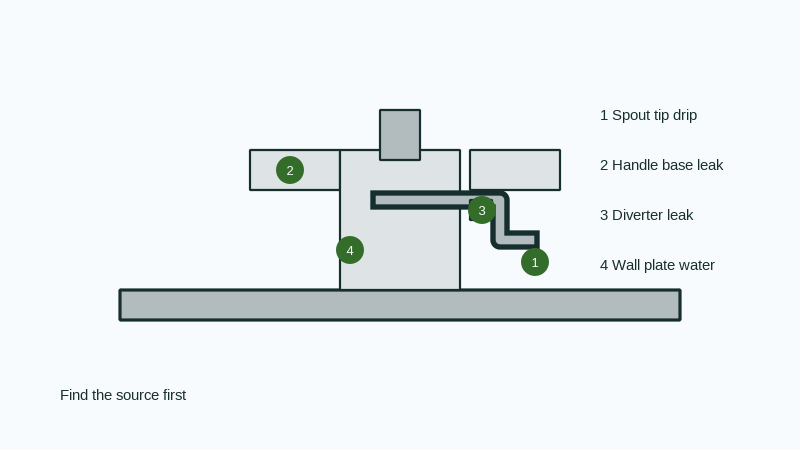
First, watch where the water comes from. If the tub spout drips with the faucet off, suspect a cartridge, washer or seat that has worn down; the handle area points to worn packing or an O-ring. Water coming out of the shower head as the tub fills suggests the diverter. Each has a different remedy. For more fixture work, look at the guide to sink and disposal plumbing.
Where exactly is my bath faucet leaking from?
Find the exact origin before buying anything. Dry the faucet, then look over the spout, the handle bases and the wall plate. A drip at the spout is a fault inside the valve. A damp handle base is a seal problem. Water behind the wall plate or on the ceiling beneath calls for a plumber, as it could be a supply leak.
Quick reference:
| Leak location | Probable culprit | Start with |
|---|---|---|
| Spout, constant drip | Aged cartridge, or a washer and seat past their life | Replace the cartridge, or the washer plus seat |
| At the handle | Failed O-ring or loose packing nut | Snug the nut, change the O-ring |
| Shower head while the tub runs | Tired diverter | Swap the diverter spout or valve |
| Inside or under the wall | Leaking supply or valve body | Close the water, hire a plumber |
| Spout and handles together | Corroded valve body | Replace the valve |
Identify the faucet style next. A pair of handles, one for hot and one for cold, generally means a washer or cartridge on each side. One handle generally has a single cartridge.
When should a plumber handle a leaky bath faucet?
Hire a plumber when the faucet will not close at its own valves, corrosion has eaten the valve body, water is leaking inside the wall, there are no isolation valves and the main valve fails, or you cannot find parts. A local plumber can swap the valve and open an access panel in the wall.
Signs this is not a simple fix:
- A handle or stem that refuses to come off.
- A corroded or cracked valve body.
- A water stain on the ceiling below the bathroom.
- Shut-off valves that do not seal.
- No access panel behind the tub wall.
When you send a quote request, mention the brand if you know it, the number of handles, and where the leak shows. Your request is passed along to a local plumbing business, and the business that accepts it pays us a fee. In California, paid plumbing work above a small threshold needs a contractor license, which you can verify on the CSLB website.
What does a dripping tub faucet cost in water?
More than most people think. According to EPA, a faucet dripping about once every second can waste over 3,000 gallons of water yearly. A dripping hot tap also throws away heated water, which means gas or electricity. A weekend repair using a small kit usually pays for itself in saved water.
EPA further recommends closing the water supply before any faucet repair, and reading the meter after two hours with no use to spot hidden leaks. If the meter keeps moving with every tap off, the faucet is not your only leak.
Another point: dripping leaves mineral stains in the tub that look like rust or limescale. White vinegar helps clean them, and fixing the drip keeps them from returning. For the scale itself, see removing hard water scale.
Why does water reach the shower head while the tub fills?
The diverter sends water up to the shower head when you pull a knob or lift a lever. When it wears, water trickles to the shower during tub filling, or sprays from both outlets. Replacing the diverter spout, or the diverter cartridge on a three-handle valve, normally cures it.
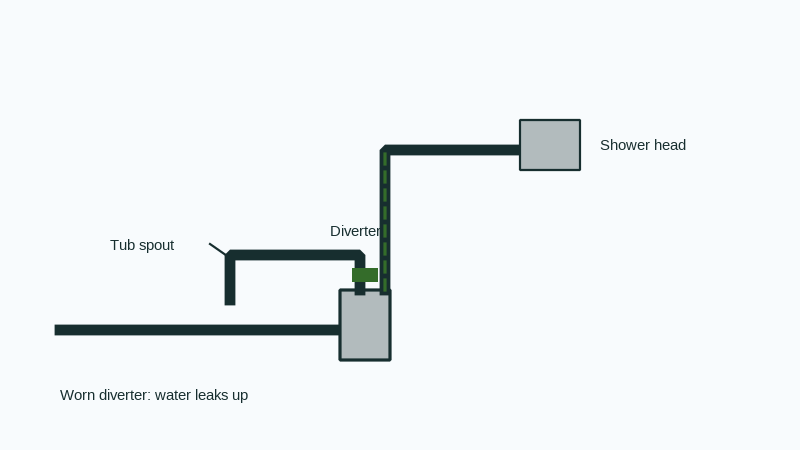
Spout diverters come in two kinds:
- Slip-on spouts are held by a set screw on the underside. Loosen it and slide the spout off.
- Threaded spouts unscrew counterclockwise with a pipe wrench wrapped in cloth.
A worn diverter spout is often cheap, and fitting a new one is simple. A diverter inside the valve body is more work. If the shower head still drips once the water is off, the valve itself could be failing. Read our shower faucet repair page.
What is the fix for a dripping two-handle tub faucet?
A tired rubber washer, a pitted seat or a failed cartridge causes two-handle leaks. Turn off the supply, take off the handle and trim, draw out the stem, and replace the washer or cartridge on the leaking side. If the seat is rough, resurface or replace it, then reassemble.
Steps:
- Turn off the water. Close the isolation valves if present, otherwise the main valve. Open the faucet so the line empties.
- Plug the drain. A screw that falls in is hard to recover.
- Take off the handle. Pry the cap, remove the screw, and pull the handle straight away. A corroded handle may call for a puller.
- Remove the trim and the packing nut, then unscrew the stem.
- Check the washer or cartridge. A washer sits on the lower end of the stem. Fit one of identical size, and swap the screw if it has rusted. A cartridge pulls straight out and gets an exact match.
- Check the seat. Run a fingertip around it. A rough seat chews up a new washer, so replace it using a seat wrench or smooth it with a reseating tool.
- Reassemble and test. Leave the water off at first, then open it slowly.
A hardware store can help you find a match if you bring the old part. If the faucet is old and spare parts are hard to find, buying a whole new one may be wiser. The two-handle faucet page describes a similar repair.
How do I stop a one-handle tub faucet dripping?
Dripping from a one-handle faucet comes from a worn cartridge or a bad O-ring. Once the water is off, take away the handle and the cover plate, then whichever clip or nut keeps the cartridge in place, pull the cartridge out, and fit a matching one. Some models use a ball, or seats with springs, so check how yours is built.
Notes:
- The retaining clip is small and easy to lose. Keep it in a cup.
- Note the cartridge's orientation before pulling it, since it can go back wrong and swap hot and cold.
- Coat new rubber parts lightly with plumber's grease.
- Hard water deposits can seize a cartridge. Look up hardness in the yearly water quality report from your district. Most of Simi Valley is on Ventura County Waterworks District No. 8, the eastern end is on Golden State Water, and Moorpark is on Ventura County Waterworks District No. 1.
Further cases appear on the pages about a leaking one-lever faucet and a leaky bathtub faucet.
Common questions
How much time does fixing a bath faucet need?
Replacing a washer or cartridge normally runs thirty minutes to an hour. A diverter spout takes about ten minutes. A seized stem or corroded valve body can take far longer, and a valve replacement inside the wall is a bigger job that includes wall repair.
Which questions suit the plumber ahead of the work?
Ask whether parts are included, what the minimum charge is, and whether seats or cartridges get replaced along with washers. Get the quote on paper, and before work begins check the plumber's contractor license through the CSLB website.
Does the whole house have to lose water?
Only when the faucet has no isolation valves. Many tubs have no shut-off close to the faucet. In that case close the main valve and drain the pipe through a low tap. Afterward, bring the water back slowly and watch for drips.
The faucet still drips after a new washer. Why?
Either the seat is rough or pitted, or the new washer is the wrong size. A damaged seat wears out washers quickly. Replace or resurface the seat, and make sure the washer fits snugly. If it still drips, the cartridge or valve body may be worn.