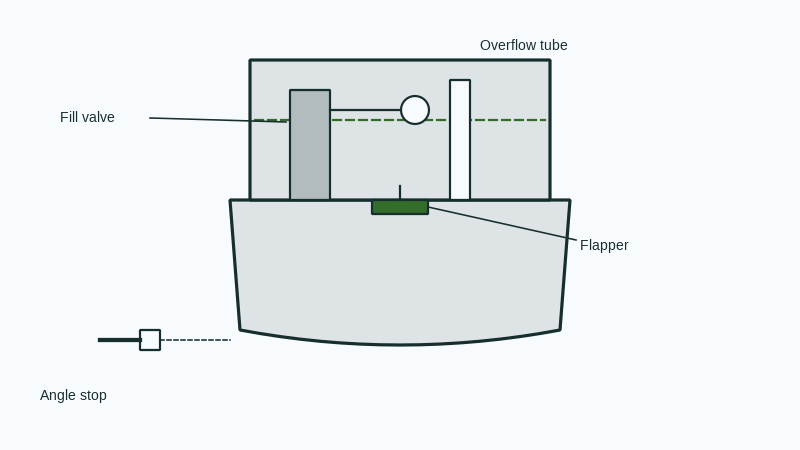
On most toilet tanks, the tall unit at the left is the fill valve: it admits water after a flush and closes at the proper level. A toilet that hisses, keeps running or fills slowly often has a bad valve, and changing it takes roughly half an hour. The diagnosis, the steps and the limits follow. Prefer to hand the job over? The home page links to the quote form.
How do I know the fill valve is the culprit?
A faulty fill valve shows up as a hiss once the tank is full, water running into the overflow tube, a very slow refill, or an overfilling tank. A flapper fault looks different: the tank drains down slowly, and the fill valve starts up by itself every few minutes.
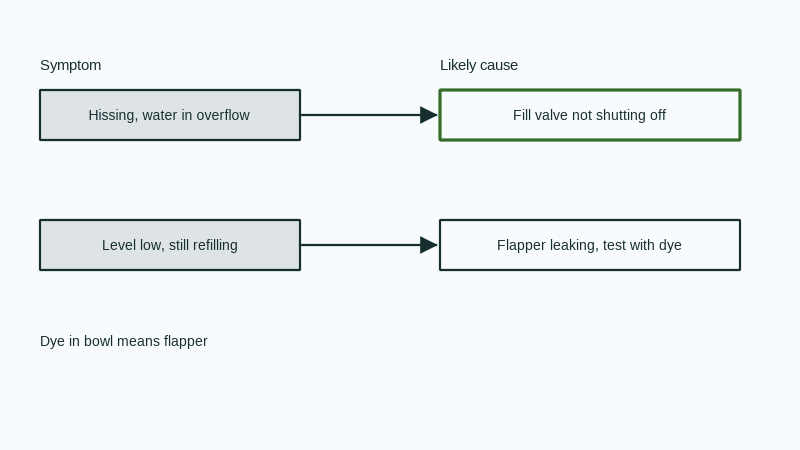
A quick test: lift the lid and watch. Water spilling into the white overflow tube means the valve fails to shut off, or the level is set too high. When the level stays well below the overflow tube yet the toilet keeps refilling, the flapper is leaking. Stir a little food coloring into the tank, leave it ten minutes without flushing, and check whether color reaches the bowl. Color there points at the flapper, not the valve. The toilet flapper repair page deals with that case.
What tools and parts do I need to swap a fill valve?
Collect a new fill valve with the same fitting size, an adjustable wrench or pliers, a small bucket and a sponge, plus a new supply line when the old one is crusty. Universal fill valves suit most toilets and cost little. Bring the old valve along to the store so the height matches.
Check the supply line for corrosion at the same time. A braided line is cheap and worth swapping while the tank is empty. Stop if the shutoff valve under the toilet will not turn, or drips at the stem. Forcing a seized angle stop can crack the fitting, which is reason enough to call a plumber. See toilet repair shutoff valve.
How do I swap a toilet fill valve?
Close the angle stop, flush the tank dry, soak up the remaining water with a sponge, disconnect the supply line, remove the locknut beneath the tank, pull the old valve, insert the new one, tighten its nut by hand and then one more quarter turn, reattach the line, then set the height and water level.
In more detail:
- Rotate the angle stop fully clockwise. Flush and hold the handle down so the tank drains.
- Sponge up the leftover water. A small bucket helps.
- Loosen the coupling nut that joins the supply line to the valve tail below the tank. Keep a towel handy.
- Unscrew the locknut holding the valve to the tank, and remove the valve from the tank.
- Set the new valve into the hole, set its height so the critical-level mark sits over the rim of the overflow tube, and thread on the locknut by hand with a small extra turn.
- Reconnect the supply line, attach the refill tube's clip to the overflow tube, then turn the water on slowly while checking for drips.
- Adjust the float so water stops about an inch under the upper end of the overflow tube, or at the mark inside the tank.
Do not overtighten plastic nuts. Porcelain cracks under force, and a cracked tank means a new toilet.
Why does the toilet run after a new valve?
If it keeps running, the likely suspects are a leaking flapper or seat, a float set too high, or a supply line feeding a worn valve. Test them in that order. A flapper that no longer seals is the most frequent second cause, and a new one costs very little.
Look at the flapper chain too. If it is too short, the flapper is propped open; if too long, it can slip under the flapper. Either mimics a bad valve. Each cause is covered in the pages on toilets that keep running and toilets that run without stopping.
Is a toilet connected to burst pipes?
A toilet seldom bursts a pipe by itself, yet a failed supply line, a corroded angle stop or a pressure surge can burst the connecting pipe below or behind it. That may pass for a toilet leak. If water appears at the wall or floor, shut the angle stop and trace where it starts.
With a burst on the supply side, the shutoff is what saves you. Close the angle stop, and if flow continues, close the main. Next, read how to respond to a burst pipe emergency. A toilet leaking at its base is a separate fault, usually a worn wax ring, discussed in plumber for a toilet leak.
Does hard water shorten a fill valve's life?
It can. Mineral scale collects inside the valve and on the seat, and scaled valves may stick open or shut. No confirmed hardness figure for Simi Valley or Moorpark is available here, so check the yearly water quality report from your provider for yours.
If a valve fails every year or two, and the tank interior has crusty white or tan buildup, scale is the probable cause. A softener eases the problem across the whole house. Removing hard water scale describes the signs and options.
When should a plumber take over?
Hire a plumber if the angle stop is seized or leaking, the tank or bowl has a crack, moisture appears on the wall beside the toilet, the toilet rocks and leaks around the base, or it still runs after a fresh valve and flapper.
Send in the quote form listing the toilet's age, the parts you replaced and what you see. Local plumbing businesses receive it from us, and one replies with a price. Weekday form requests are handled between 9am and 5pm. The page on replacing a toilet helps if the toilet is so old that a new one makes more sense.
Common questions
How many minutes does a fill valve swap take?
First-timers need about thirty minutes, with tank draining and level adjustment included. A stiff shutoff valve or a supply line needing replacement adds time. The plumber can typically wrap up within one short visit, often alongside another toilet fix.
Are all toilet fill valves the same?
No. Height range, tail size and mounting style vary, though most universal fill valves cover the usual tank sizes. Check the packaging for the height range and match it to your tank. Older two-piece toilets and low-profile tanks sometimes need a particular model.
What should I ask before hiring a plumber for toilet repair?
Request the price or hourly rate up front, whether parts are included, the length of the visit, whether the flapper and supply line get inspected while there, and the California contractor license number. The state CSLB website can verify that number.
Can I swap a fill valve on my own safely?
For most owners, yes. The risks are overtightening plastic fittings, cracking the tank, and running into a seized shutoff valve. No gas or electrical work is involved. If the shutoff will not fully close, stop and let a plumber replace it first.