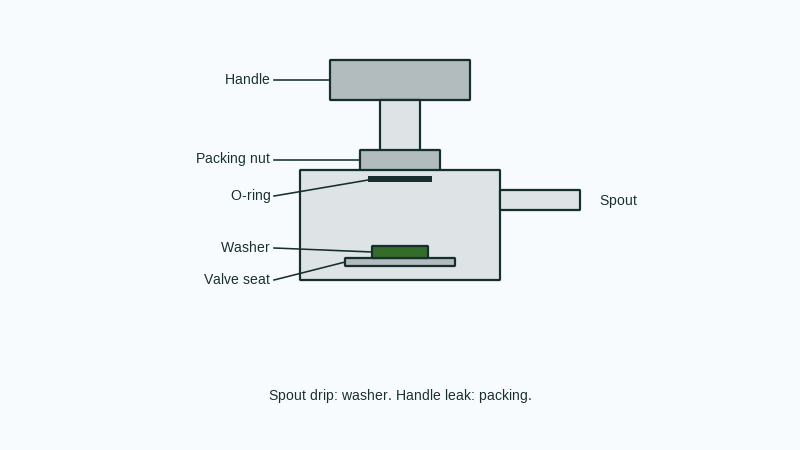
Behind almost every dripping bathroom faucet sits a worn rubber part inside the handle, and the fix runs in four moves: cut the water, open the handle, swap the part, reassemble. Only the faucet type changes the details: two handles usually point to washers, while a single lever usually points to a cartridge. Both are covered below. This topic belongs to a wider group of pages about sinks, showers, faucets and disposals. If the faucet is beyond saving, send in a request. The request goes to a local plumbing company that can fit a new faucet, and the businesses that take requests pay us a fee.
Before you start, which faucet type is it?
Study the shape and count the handles. Two handles that rotate through several turns typically hold rubber washers. A lever that swings sideways and tilts up and down usually holds a cartridge or a ball. A quarter-turn handle means a ceramic disk. Knowing the type spares you a wrong purchase.
Photograph the faucet, and the part once it is out. Carry the old piece to the store for matching, and note any maker's name printed on the handle or spout. Gather an adjustable wrench, a screwdriver, a thin flat blade for prying off caps, penetrating oil for stuck parts, a rag, white vinegar and a towel in the basin so tiny pieces cannot drop down the drain. Plug the drain before starting.
How do I close off the supply before starting?
Rotate each of the two small shutoff valves under the sink clockwise until it stops. Next, turn the faucet on so the lines empty, and check that the flow has ceased. Should the valves refuse to turn or fail to seal, shut the home's main water valve instead and plan on a plumber replacing them.
Seized shutoff valves are common on older homes. Do not force one, because a corroded valve can begin leaking once turned. If that happens, shut the main valve serving the entire house, finish the repair, and replace the sink valves afterward. Our page on fixing a toilet's shutoff valve describes the same kind of valve and what to inspect.
How do I stop a two-handle faucet from dripping?
Start by prying off the handle cap, then undo the screw beneath it and slide the handle away. Then use a wrench to loosen the packing nut and draw the stem out. On a compression faucet the rubber washer sits at the stem's tip and a small screw secures it. Replace the washer and the O-ring, rinse away mineral buildup, add a little grease, and reassemble.
A drip from the spout means the seat or washer is worn, whereas dampness around the handle base suggests a bad O-ring or packing. Match the washer size exactly, since the wrong size still leaks. A pitted seat inside the faucet body calls for a seat wrench or resurfacing tool, and by then many people choose a new faucet. The article on two-handle faucet drips goes deeper on this type.
How do I stop a single-handle faucet from dripping?
Remove the cap, then the set screw, and lift off the handle together with any trim collar. Next take out the retaining clip or nut and draw the cartridge straight out. Buy an identical cartridge and press it in with the same orientation. Replace the O-rings, put everything back together, and restore the water supply.
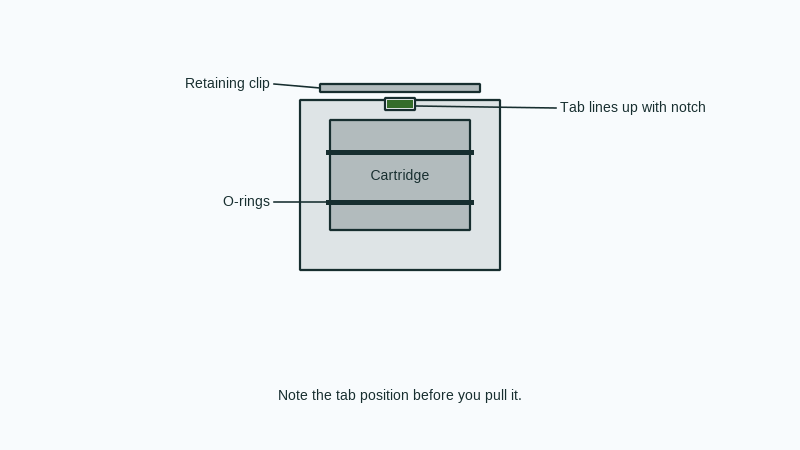
Cartridge orientation matters, so mark where the notch or tab points before pulling it. Ball-type faucets need a repair kit with springs and seats, and ceramic-disk faucets need a new disk cartridge. When the faucet is aged and its parts have been discontinued, a replacement makes better use of your time. You will find the tool list in our guide to single-lever faucet repair.
Why does the faucet still leak after the new part?
Common causes: the wrong washer size, a pitted valve seat, a cracked O-ring, a packing nut that has worked loose, or a misaligned cartridge. Hard-water scale can also keep a seal from closing. Pull the part again, feel the seat with a fingertip, and clean it using vinegar.
Hard water deposits minerals that wear rubber and scratch seats. Your water supplier's annual quality report states the hardness; in Simi Valley that is Ventura County Waterworks District No. 8 for most homes or Golden State Water in the east, and in Moorpark it is District No. 1. For cleaning aerators and spouts, see the guide to dealing with hard water scale. Replace the faucet if a second repair fails.
What does a drip cost me if I wait?
More than you might expect. According to the EPA, one drip per second adds up to over 3,000 gallons lost in a year, while a typical home loses upward of 9,300 gallons yearly to leaks of every kind. Stopping a drip ranks among the cheapest water savers in a house.
A drip left alone also stains the basin and can wear the seat further. If you cannot fix it soon, snug the handle gently and avoid cranking it shut, which wears out the washer faster. The general version lives in our faucet repair overview, and a separate guide on kitchen-style sink faucets covers those spouts.
When is it time to hand the job to a plumber?
Bring in a plumber when the shutoff valves will not shut, a second repair has failed, the faucet body has corroded, water collects under the sink or within the wall, or you simply prefer to replace the faucet. The plumber can inspect the supply lines and the drain at the same time.
Fitting a new faucet is a short job, though corroded valves and aging supply lines can stretch it. Ask for a written quote naming the faucet, any valves or lines being swapped, and who removes the old unit. California generally requires a contractor license once labor and materials add up to $1,000. A faucet swap rarely does, yet the rules still cover bigger jobs. Compare typical charges to fit a faucet with the cost of a faucet replacement. Someone reads form requests Monday to Friday, 9am to 5pm. Return to Arroyo Simi Plumbing.
Common questions
How long will repairing a bathroom faucet take?
Allow about an hour for a first attempt, plus a store trip if you lack the part. Someone experienced finishes faster. Stuck parts, corroded shutoff valves and hard water scale all add time. Snap a picture at every stage so the reassembly goes back in the right order.
Can I fix a faucet while the water is still on?
No. Shut the water off first, whether at the valves beneath the sink or at the main. Pulling a cartridge or stem from a pressurized line sends water spraying from the faucet body. After closing the valves, open the faucet to relieve the pressure, then start work.
Which parts do I need for a dripping faucet?
That depends on the type: washers and O-rings for compression faucets, a cartridge for most single-handle ones, a repair kit for ball types, and a disk cartridge for ceramic ones. Compare against the old part, and pick up a little plumber's grease too. Brand-specific parts are best ordered by model.
Does repairing beat replacing a leaky faucet on cost?
A repair costs less when the faucet is sound and spare parts can still be bought. Replacing wins when the body has corroded, the finish has worn away, parts are discontinued or two repairs have already been needed. A plumber's written quote shows the gap for your faucet, shutoff valves and supply lines included.