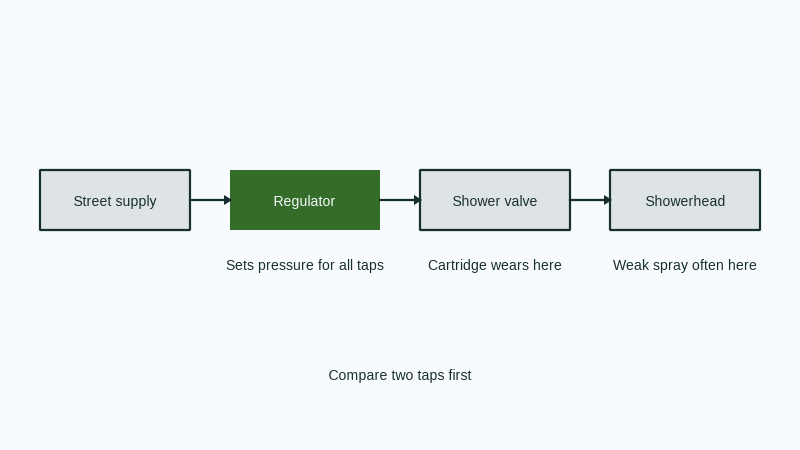
People searching for a shower pressure regulator are usually dealing with one of two troubles: a weak shower, or one that bangs, leaks or spits. The regulator can contribute to either, though seldom all of it. Below, the regulator's role is separated from the roles of the showerhead and valve. It belongs to the wider guide covering taps, sinks, showers and garbage disposals. Other jobs we pass to local plumbers in Simi Valley and Moorpark are on the home page.
Can a pressure regulator change how a shower behaves?
Yes, though indirectly. A whole-house pressure regulator is installed at the point the water line enters the home and sets the pressure every fixture receives, the shower included. If it fails high, the shower valve may leak or bang, and if it fails low, every tap weakens together. A shower rarely needs its own regulator.
Typically the regulator is a valve shaped like a bell, installed on the main line right beside the shut-off. If you are unsure what yours looks like or where it is, see the pages on the regulator's appearance and where it is located. Not every house has one, and some lost theirs when the plumbing was altered.
A shower cares about pressure since the valve in the wall, the cartridge and the showerhead each operate within a pressure range. High pressure can wear them out early, and pressure that is too low gives a feeble spray. The regulator keeps the supply between those extremes.
Is there a regulator designed only for showers?
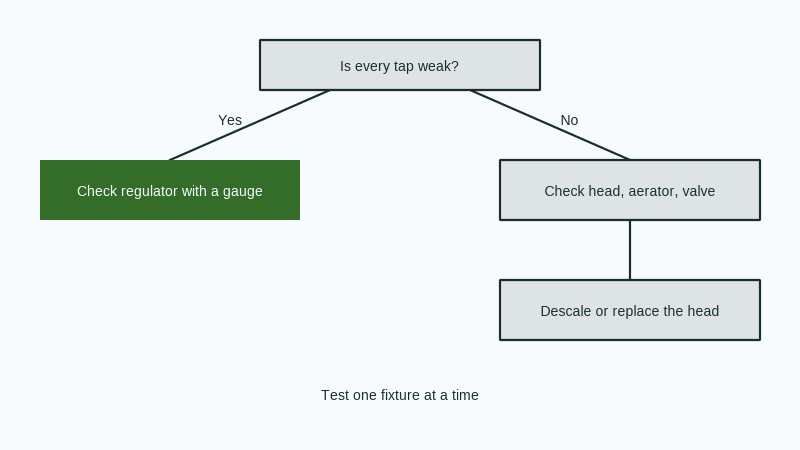
Generally no, at least not as an extra pressure-reducing valve. Showers get flow-limiting showerheads and pressure-balancing valves that steady the temperature, which are separate jobs. When pressure is poor throughout the house, the cure is at the main regulator. When only the shower is affected, inspect the head, the valve and the pipe.
A pressure-balancing or thermostatic valve helps keep the temperature stable when someone flushes a toilet or opens a tap elsewhere. That is a comfort and scald-protection feature, not pressure reduction. If your shower swings between hot and cold, a cartridge or valve fault is more likely than the regulator, and a plumber should inspect it, because scalding is a real risk.
A flow-limiting showerhead lowers gallons per minute and does not regulate pressure. The guide to the best low-water-pressure showerhead helps with choosing a head for a weak supply.
How do I test for a pressure problem?
Screw a pressure gauge onto an outside spigot or the washing machine connection, shut every tap in the house and note the reading. The gauge produces a number to compare with the regulator's rating and to hand to a plumber. Measure at a quiet time, then again with a shower running, to see how far pressure falls when water flows.
Gauges are inexpensive at a hardware store and read in pounds per square inch. We set no target number, because the right range depends on your fixtures and the regulator's rating; the plumber can tell you what is normal for your house. The pattern is what counts: very high at rest, a large drop under use, or a steady low reading.
If the gauge reads normal but the shower is weak, the fault lies after the regulator: the showerhead, the shower arm, the valve or scale in the pipes. The USGS notes that scale builds up over long periods, narrowing pipes, cutting flow and lowering pressure, so older plumbing with hard water can restrict flow even when the supply is fine. More is in the guide on preventing hard water scale.
Who should adjust or replace the regulator?
This is plumber territory: the regulator sits on the main supply, so the water has to be turned off, and the work may require a permit. Do not turn its adjusting screw chasing pressure without a gauge, since a wrong setting can strain fixtures and pipes. A local plumber can test, adjust or replace it and report the gauge reading before and after.
Ask which regulator the plumber would install, how it is rated, and whether the quote includes the gauge test, a new union or shut-off valve if needed, and the permit. The City of Simi Valley and the City of Moorpark each run a Building and Safety office, and a plumber can say whether the work needs a permit where you live.
Send the quote form and describe how the shower behaves, whether other taps are affected, and any gauge reading you have. A local plumbing business receives your request and puts a written quote in your hands before work starts. We are paid a fee by the businesses that take on requests. Someone reads the form on weekdays, 9am to 5pm. Should water be leaking at the main, close the house valve first.
What shower symptoms suggest a regulator fault?
Excess pressure appears as pipes that bang, taps that spit and fixtures that leak or wear out early. Low pressure appears as weak flow at every tap, not only the shower. A shower that is weak while the kitchen sink runs strong points at the shower head or valve instead of the regulator. Compare two or three fixtures before blaming the regulator.
A bang when a tap shuts is water hammer, which may stem from high pressure, loose pipes or a failed arrestor. The water hammer guide lists the causes. A shower that drips after being turned off may have a worn cartridge or seat, covered in a leaky shower faucet.
Further signs of a failing regulator are pressure that swings from strong to weak through the day, pressure that creeps up overnight, and a relief valve on the water heater that drips. Several of these together make the regulator a prime suspect. If only the shower misbehaves, it probably is not.
Will changing the showerhead or regulator cure a weak shower?
Often the head is to blame, not the regulator. The EPA says WaterSense showerheads use at most 2.0 gallons per minute, against 2.5 for a standard head, and the label requires a minimum flow across a range of household pressures. Mineral scale can also clog the spray holes, so descale or replace the head before examining the supply.
To descale, take the head off, leave it in white vinegar to soak, then brush the holes. If the spray remains weak, take out the flow restrictor where the manufacturer allows, or fit a head rated to perform well at lower pressure. Never drill out the holes, which ruins the spray pattern.
When every fixture is weak and the gauge confirms low pressure, the regulator may be failing or set too low. Swapping it out falls to a plumber; read regulator replacement and a whole-house pressure regulator to see how it goes. Some homes also have a regulator on a single line; the pages on a hot water pressure regulator and a washing machine pressure regulator cover those cases.
Common questions
How much time does swapping a regulator need?
With the right unit and easy access, a plumber often finishes within a short visit, though a stuck main valve or an old pipe can stretch it. The plumber will give a time estimate on the day. Requests sent through the form carry no promise of response times.
Which questions go to the plumber about weak shower pressure?
Check whether the visit includes a gauge test, what follows should the shower valve or pipe turn out to be at fault instead of the regulator, and whether replacement parts and any permit are in the quote. Get the price on paper, and verify the contractor's license on the website of the state's contractor licensing board.
Could a regulator make the shower run too hot or too cold?
Not directly. Temperature swings usually come from a worn shower valve cartridge or pressure-balancing valve, or from the water heater. A failing regulator can alter flow, and a change in flow may be mistaken for a change in temperature, so a plumber should check both.
Does an adult have to be present for the replacement?
Yes. A household adult needs to point out the main valve and the regulator to the plumber, and to agree what will be done. The water is shut off while the plumber works, so schedule showers and laundry around the visit, and clear the space around the main.